
by Michael K. Iwoleit
Translated by Mike Mitchell
‘There’s a quite simple explanation,’ said Harold. He was a short, notoriously good-humored man with receding hair, the beginnings of a paunch and rings under his eyes; no longer quite the great organizer and motivator of his earlier years, he was still astonishingly energetic for a man just turned seventy. And still a lot more on the ball than Konrad. ‘Your problem’s Adam’s navel, of that I’m quite sure.’
Harold had supervised Konrad’s doctorate. They had met again a few years ago at a reception given by a firm that ran genetic databases. Harold still had a half-time position on the advisory board and had offered him a job. However, by that time Konrad had already decided to give up research in order to pursue his interest in writing and try to establish himself as a science journalist. He remembered Harold as a hard taskmaster who would stop at nothing to worm the maximum their talents would allow out of his students. But Harold was also impressed by people who were willing to take a risk and so he’d offered to help Konrad in his new career. Konrad could always rely on him when things got difficult — though that didn’t mean the old man made it easy for him.
‘I’ve been accused of many things,’ Konrad growled, ‘of being lazy and disorganized, of lacking discipline and concentration, but that that’s my problem . . .’
‘You disappoint me, my son. My mind was sharper at your age. But that’s probably our fault. If we hadn’t spent so much time in the eighties boozing, snorting and sleeping around, your generation would have better genes.’ Unshaven, casually dressed and with one elbow on his desk, Harold was sitting in an office that was bigger than Konrad’s apartment. A woman’s hand, elegantly manicured, appeared on the screen and placed a cup of coffee in front of him. He grinned, like a patriarch who can have the prettiest girls come running at a click of the fingers. ‘Don’t say you don’t know the story? In the old days we used it to catch out the Christian fundamentalists who protested at public meetings against the teaching of evolution in schools. That ring a bell?’
‘No comment.’
‘Oh the ignorance of youth! It goes roughly like this. Just ask one of these peabrains who take the Biblical account of the creation for the literal truth whether Adam and Eve, the first human beings, had a navel. If they didn’t, then they obviously lacked something and were not complete human beings in the image of God. If they did, then they had a bodily feature that came from their birth and they can’t have been the first human beings. For a long time it was a genuine problem for theologians and the Christian painters of the Middle Ages and the early Renaissance could not agree whether they should paint the couple with navels or not. You can’t imagine the knots the defenders of the pure faith would get themselves tied up in when I put that to them. It was great fun, but the real joke was that virtually none of them knew that one of their fellow believers had found a solution as long ago as the middle of the nineteenth century —’
‘I remember now. Philip Henry . . .’
‘Correct. Philip Henry Gosse, an important British biologist and the author of an obscure work called Omphalos, which was published in 1857, that is two years before Darwin’s Origin of Species. It’s a remarkable book in which Gosse deals not only with Adam and Eve’s navels, but also with the fact that they presumably had hair, nails, teeth, bones and all sorts of other parts of the body which usually show signs of growth. Worse still, there is overwhelming evidence that the earth and life on it are much older than the four or six thousand years the Bible allows — geological findings, fossils, long-lived micro-organisms, biochemical affinities between species and so on. Poor old Philip was torn this way and that. On the one hand he was a scientist who could not simply dismiss empirical data. On the other hand, as a respectable Christian he could not cast doubt on the truth of the divine revelation. So what was he to do? That was when he had one of the most brilliant pieces of lateral thinking ever to occur to man. Gosse claimed that God had indeed created the world four thousand years ago, including all the characteristics which give the impression that the earth and its creatures are much older, that is the traces of a past that had never existed. Whether the Lord did it to play a joke on us or to test our faith is another question. Whatever, Gosse didn’t have to reject any empirical evidence and his solution was still consistent with the Biblical story of the creation. Fantastic, isn’t it?’
‘But I don’t see what that has to do with my current research.’
‘So what? You didn’t call me to help you along with a few crummy little routine stories, did you? You’re short of money, am I right or am I right?’
‘How well you know me.’
‘Good, then don’t spoil my punch line.’ Harold leant back, exuding smug complacency, took a sip of coffee and pulled a face. ‘You know you can always learn something from old Harold so pin your ears back, this is it. At the time Gosse was laughed out of court — even by the theologians he was trying to give a scientific basis for argument. But modern physics has revived his idea. Many cosmologists assume our universe is just a time-space bubble in a cosmic superstructure, one of many fluctuations in a supervacuum which appear and disappear spontaneously like virtual particles. Each of these bubbles has different characteristics, its own natural laws, natural constants, its own history. It’s as if the cosmos were trying out all possible ways of constructing a universe. Thus it’s possible that universes could arise which give the impression they’re older than they really are. Perhaps our universe is just five minutes instead of thirteen billion years old and all the clues pointing to a past, from the expanding universe to our own memories and experiences, are merely a random configuration. I’m not making this up — some cosmologists have put it forward seriously. Gosse’s theory is simplicity itself compared to them, eh?’
Konrad repressed a sigh. With one eye he squinted at his second monitor and shuddered at the long list of demands that had collected in his e-commerce mail box: information services, web magazines, mobilcom providers, all complaining about direct debits that had been refused. One email he had just opened tried to lighten its unambiguous warning with a playful animation, a waving hand, which looked to Konrad more like someone waving their fist.
‘Was that my lesson for the day?’
Harold rolled his eyes. ‘Why are you always so impatient, man? Why do you think I’ve just been fiddling with my keyboard? A little matter of 5,000 euros I’ve transferred to your account. That’ll be enough for you to eat over the weekend, won’t it?’
‘If I lower my expectations a little.’
‘Now get those little gray cells working. I’m not doing this for fun, you know. I’m going to explain something that’ll be a lot more use to you than those few bucks. Right then, listen up, this is the important bit. If it is the case that the universe, with all its observed characteristics, is simply the result of a spontaneous process — and, from a purely logical point of view, that cannot be excluded — then the laws of nature, which we derive from regularities we have observed, are simply an illusion. Let’s assume the universe — and us along with it — came into being only five minutes ago. On the basis of the characteristics this universe assumed spontaneously, we imagine that mankind has been investigating regular occurrences in nature for centuries. And in the next five minutes, or five years or whatever, we are going to discover that the cosmos doesn’t give a shit for our laws of nature. The fluctuation we call the universe is not stable. The natural constants vary, the laws of gravity don’t operate any more, the moon is hurtling towards the earth. In a few weeks things are going to get pretty uncomfortable. Just think about it — and you’ll have an explanation for the odd things you told me beforehand.’
Harold was notorious for his extravagant flights of intellectual fantasy. Usually It was something perfectly ordinary he was getting at, but he could get hopping mad if people did not pay attention while he meandered through half the Western intellectual tradition.
‘You cannot be serious,’ Konrad said. ‘What have a shopping mall in Shanghai, a dam collapsing in the Indus valley and a statistics office on Wall Street —’
Harold waved his hands about as if trying to ward off a swarm of flies. ‘I’ve no idea,’ he said. ‘Do you think I seriously believe all the shit I’ve just told you? I’m getting worried about you, man. I’ve just had a look on your server. No new article for weeks. And the stuff before that — as boring as the rubbish you’re wasting your time on now. Look at the take-up. Who buys your stuff? Only third class webzines that can’t get anything else. What’s to become of you? Should we all start sending you food parcels?’
‘So what do you think I should do?’
‘Get your brain working. Use your imagination. Make interesting connections. If I can do it, then surely you can. Isn’t that why you became a writer in the first place? Bold speculation, crazy theories, hogwash at the highest intellectual level. In no time at all you’ll be leading the pack.’
‘I vaguely remember a certain supervisor who came down like a ton of bricks on the slightest speculative digression.’
‘That same supervisor would have told you the exact opposite if he’d been training you to become a hack. I’m not God, I’m just the kick up your ass.’ He clasped his hands behind his head, took a deep breath and gave a sigh of relief. It sounded as if he’d just made a great effort, but also really enjoyed it. ‘So, do we go for it?’
‘Can I have lunch first?’
‘For all I care you can blow the whole 5,000 euros on whores, if it helps. But just remember — from now on I’m keeping an eye on you. I’m giving you an ultimatum, a deadline: if you haven’t produced something by then, you can see how you manage on your own.’
Let’s hope that’s just another joke, Konrad thought. ‘By when?’
‘Twenty years from now. By then I’ll have had enough. So back to the keyboard, my son.’
‘I’ll start right away. We’ll see each other at the end of the month.’
‘Of course.’
Sylvia was already waiting on the other line. Oh great, thought Konrad, it’s open house today. Come on, everyone have a go at me, it’s just what I need. He saw a taut pair of scantily clad female buttocks cross the screen and the old philanderer break into a broad smile, as if he had just had a great idea what to do with the rest of his day. Then the picture faded into a shot of Sylvia’s living room. She was sitting on the sofa wearing leggings, her knees drawn up, her hair done casually, a green phosphorescent drink in her hand. Today everyone gave the impression they’d started their summer vacation early. Only he was sitting, uptight and lethargic, in the smokey corner of the office he shared with twelve other freelancers, without even the energy to switch off the machines, go home and get plastered.
‘Is it my agent calling or my girlfriend?’ he asked.
‘Which would you prefer?’ she said.
‘A groupie. I wouldn’t say no to someone squealing and screaming and tearing her clothes off.’
‘Give me a good reason.’
‘Such as?’
‘You know I go for clever men. Intelligence turns me on. Another piece of brilliant prose from your pen and I won’t be able to stop myself. Just imagine, live on the videostream, for lovers to download. But unfortunately … ‘
It wasn’t a good sign that at that moment the thought of a striptease, which she’d actually done for him once or twice, left him fairly cold. It wasn’t her fault. She was still the same Sylvia, a tall, powerful woman who called a spade a spade and had a preference for men who were a little afraid of her.
‘So it’s business?’
‘You were determined to have me as your agent, so why complain when I’m just doing my job?’
‘OK then, as of now you’re on leave of absence. And as your boss I order you to put on your skimpiest bikini and go and sunbathe in the roof garden. I’ll watch you on the webcam.’
‘Why not — except that just now you’re not my boss, you’re a walking disaster.’ Her expression became serious. ‘Three weeks ago you said you were working on several hot stories and needed a little time. OK, no problem. But I have the feeling you’ve been wasting your time again.’
‘Rubbish. They’re coming along well. Just a few more days.’
‘Lies and more lies. Who did you spend all that time chatting to just now?’
‘No one you know.’
She snorted, as if she were talking to a naughty child. ‘D’you think I’m stupid? How much did you hit Harold for this time?’
‘Business secret.’
‘And obviously I’ve nothing to do with your business, I can see that.’ For a moment she bit her lower lip. ‘Come on, out with it. If you’ve been sitting on your butt for three weeks I can live with that. But don’t try and tell me you’re following up some sensational stories.’
‘No, I wasn’t lying. They’re interesting, really. It’s just that … Somehow I’ve got stuck. There’s something fishy going on, perhaps there’s even a connection between the stories. I just can’t find out what …’
‘OK then, let’s go through the things together and then we can decide what’s to be done. Perhaps I can help you.’
Sylvia had a glittering career as editor with all sorts of different web and print journals behind her and as a late starter had reached astonishing heights in scientific journalism. And it wasn’t only in professional matters that she showed him the way. Since they had met two years previously, he couldn’t make up his mind how their relationship should develop in the long term, but that didn’t bother her, no more than the fact that he occasionally took refuge from her imposing presence in less problematic little affairs.
‘You’ve probably already heard about the project in Shanghai,’ he said. ‘It was meant to be an exemplary joint venture between that way-out American architect, Waters from Chicago, and the Mei Ling Software Corp., which develops VR environments and expert systems for architects. You know the kind of thing: intensification of US-Chinese economic relations, exchange of know-how, test runs for the markets of tomorrow, blah, blah, blah. The important factor for the Yanks was that the Chinese had promised long-term cooperation with juicy investment if a prestigious building could attract new contractors to undertake large-scale projects. So they needed something spectacular and there Waters was in his element. Perhaps you recall the business mile he put up in Teheran when American firms took over the place after the war. The whole of the industry’s jealous because no one’s yet been able to work out how he gets his buildings to stay up. Personally I don’t like them, to me they just look like crooked scaffolding. But it is fascinating how he manages to hang the whole of the floor space in a structure consisting of a few twisted steel and concrete supports.’
‘Didn’t they flatten half a kilometer of buildings for him along the Huang-p’u?’
‘That’s exactly what I’m talking about. The Chinese thought the English colonial buildings had been a blot on the landscape for far too long and it was time for something a bit more hip. Waters put a gigantic suspended roof over the whole complex, eighty meters high and spanning almost twelve hectares. It looks like a seashell and under it the shopping arcades are arranged all higgledy-piggledy over each other so that you wonder how the whole thing’s going to hold together.’
Sylvia shook her head. ‘Why’re you bothering with this? There were reports about it everywhere last year. As long as the thing doesn’t collapse no one’s interested.’
Konrad gave a knowing grin, though to go by Sylvia’s reaction, not a very convincing one. ‘Just imagine, I have clear indications that is exactly what’s going to happen. This time Waters has gone to far with his experimental structures, the whole shopping mall’s slowly tilting towards good old Mother Earth. Another two months and there’ll be a big bang and that’ll be it. Since Waters drew up the plans using Mei Ling’s software systems — naturally — at the beginning they each tried to put the blame on the other, but since then they’ve got together and ganged up on the hardware suppliers, Hewlett-Packard. H-P didn’t want a compensation claim going into billions hanging over their heads, so they sent a team of programmers to Shanghai and demanded access to Mei Ling’s source code in order to compile and test out the software on several independent systems. The poor bastard who’s responsible for the series of tests must be close to a nervous breakdown by now. No serious bugs were found, neither in the hardware nor in the software, but despite that, every simulation produced different results. Sometimes it looked as if Waters’s calculations were correct, sometimes as if the whole thing should have collapsed during construction. And at others it was different again. A genuine mystery. No one knows what’s going on.’
‘Apart from you?’
‘No, I haven’t the slightest idea either. That’s my problem. But I’ll —’
Sylvia broke in. ‘That’s enough, lover boy.’ He could tell she had to make an effort not to bawl him out. ‘That’s exactly what I thought. I know you through and through, darling, you always go for this kind of thing when you feel under stress. You don’t want get any further with it. You just want to crawl away and hide.’
‘What is it you’re getting at?’
‘An investigative journalist who’s got nothing to investigate. Are the other things just as flimsy?’
‘What do you mean, flimsy? There’s a similar disaster threatening a dam on the Indus. Two million tons of of reinforced concrete are being junked. Is that flimsy?’
‘And you don’t know why there either?’
‘No. Nor do I know what’s hit these consultant guys on Wall Street. For ten years they’ve been raking in the millions with computerized exchange rate forecasts. In the last few weeks it’s all gone haywire. They can’t even get consistent results with last year’s figures.’
‘And you expect me to get excited about that?’
‘Listen.’ She was capable of driving him mad and had no scruples about doing so if she felt it was necessary. ‘In each of these cases it was an established system that had been used successfully for years. Then suddenly, out of the blue, for no apparent reason, the whole caboodle goes haywire. If there isn’t a story in that …’
‘Get a grip on yourself, Konrad,’ Sylvia said. ‘That kind of thing’s happening all the time. We’re living in a world where Microsoft has raked in billions. At least half of all large-scale software projects come to nothing. It only takes an update and with any luck the whole shebang crashes.’
‘That’s not the same.’
‘If you say so.’ She spoke in placatory tones — which was not necessarily a good sign. ‘Look, why don’t you concentrate on ordinary, boring scientific journalism for a while? Professor X of the University of Y has been awarded this year’s Nobel Prize for medicine for the discovery of a sure-fire cure for bad breath and sweaty feet. Professor A of the University of B has solved one of the great mysteries afflicting mankind by discovering why one sock and one sock alone always disappears in the wash. That kind of stuff. That story you uncovered about the schoolkids infected with hepatitis was a real cracker, true, but you’re not going to find one of those every day.’
Keep calm, keep calm, Konrad told himself. ‘We’ll see,’ he murmured, but so quietly he could hardly hear it himself.
‘How about going out for a meal?’
‘Oh dear! What’s coming? Six of the best?’
‘No. I just want to have a nice evening with you. And afterwards I’ll take you to my bedroom where I guarantee I’ll send you somewhere you can hear the angels sing.’
‘I think I can just about manage that. Where?’
‘You know where. I’ll see you in two hours’ time. And put some decent clothes on or I’ll get really angry.’
#
Sylvia had a — to me disagreeable — preference for the temples of consumerism which Asiatic investors had put up along the banks of the Rhine between Duesseldorf and Bonn in the twenties, when several cities there had been amalgamated to form the new supercity. Her favorite was the Sherrington Mall in Kaiserswerth, an incredibly grandiose structure of steel and glass boldly plonked down in the middle of the landscape. It looked as if its design had been taken directly from the covers of old American science fiction magazines. On the first floor there were so many expensive boutiques and kitschy gift shops one could easily blow a million in one afternoon without having to hire a truck to get home. Above them were thousands of empty hotel rooms waiting for the tourists the Rhine megalopolis had not yet managed to attract. On the roof terraces a handful of fancy restaurants shared the most expensive floor space in the city, a fact which was reflected in the prices if not the quality. The bland designer dishes, which were presented as international cuisine, would have had any half-decent Chinese, Turkish or Pakistani cook tearing his hair. The Italian pop muzak complemented the cooking perfectly, but the view of the Rhine was something special, particularly at twilight, when the effluents from the chemical industry took on a striking glow. And all this enjoyed in the company of the most empty-headed of the nouveau riche riffraff to be found within a radius of fifty kilometers.
Normally Sylvia had no time for ostentatious show, but she wasn’t averse to squeezing into one of her sequinned rags now and then in order to amuse herself at the mindless flaunting of an excess of disposable income. Konrad had given his velvet jacket a good brushing and rummaged round in the pile of clothes in his wardrobe until he found some things which didn’t look too shabby, at the same time practicing a cool expression in the mirror so that he wouldn’t look as if he was going to be sick any moment during the meal. As he passed through the mirrored vestibule into the Diner’s Club Special, he realized that the three-day beard he’d insisted on not shaving made him look scruffy rather than rakish, and his outfit, instead of being stylishly black, was more like that of a third-class mortician. Still, Sylvia seemed to recognize that he’d made an effort. She said nothing when he found her at a half-hidden table in one of the galleries, just beamed as he planted a kiss on her cheek and waved the waiter over.
‘I’ve a surprise for you,’ she said.
Her dress had been tailored for a slimmer figure. Konrad couldn’t take his eyes of her décolleté as he made a meal of pulling out a chair and sitting down. The bodice was stretched tight and at every breath it looked as if her ample bosom was going to burst through the material.
‘What? Are you wearing black underwear?’
She gave a faint smile, as if an adolescent had made a joke. ‘I’m not wearing any underwear at all, lover boy, but that’s not the surprise.’ She pushed a caddy over to him with a mini DVD in it. ‘There. That’ll keep you busy for the next few months.’
A slightly built, dark-skinned waiter with the sultry charm of a metrosexual came over and pulled out a notepad expectantly.
‘Tell me, what are those little things we had last time called?’ Sylvia asked. ‘Those cheese and vegetable balls with rice. Indian, you know . . .’
‘Oh no,’ Konrad groaned, earning him an aggrieved glance from the waiter.
‘Kofta. Malai kofta. But —’
‘Malai kofta for two. And whatever drink goes with it,’ Sylvia said to the waiter, laughing when she saw the pained expression on Konrad’s face. The waiter hurried on to the next table. ‘What have I done to my little darling now. Tell me, perhaps I might mend my ways eventually.’
‘You know very well that the idiots here can’t make kofta. Indian cooking’s a special art. If you insist on throwing your money away …’
‘Don’t waste your breath, Konrad. You get worked up about such a trifle, yet when your own livelihood’s on the line, you putter along like someone who’s no idea what’s in store for them.’
‘What’s all this about?’
‘I just wanted to see if you’d any juice left in you. If you can still get worked up about something. Seems you can, all that remains to do now is to direct that energy in the right direction.’
He picked up the minidisk. ‘What’s this?’
Sylvia raised her eyebrows. ‘SLHC. Need I say more?’
‘What?’ At first he was just puzzled, but then he had a sinking feeling. The Super Large Hadron Collider, a huge linear particle accelerator that had been installed at one of the L5 points between the earth and the moon, had been in operation for eighteen months and had sent the scientific illiterates of web TV and the press desperately seeing who could produce the most stupid headline. Konrad recalled things like ‘There at the Moment of Creation’ and ‘Revealing God’s Plan’. One press officer had declared in all seriousness that in a hundred years’ time the scientists involved in the project would perhaps be seen as the founders of a new religion, having succeeded in reconciling science and faith. All that nonsense had put him off the project altogether and, anyway, he wasn’t really interested in whether there was experimental proof of some of the main predictions of the superstring theory, as was claimed after the results of the first experiments had been analyzed. ‘You’re not expecting me to …’
‘Oh yes I am,’ Sylvia said. ‘I know what you think of all the carry-on, but that’s not what this is about. The sensationalist media will soon find other things to write about and that means the time will be ripe for some serious journalism. Everything my informants have been able to find out has been burnt onto that disk. The material’s incredibly complex, enough for years of solid interpretative work and commentaries. At present there’s intense discussion among specialists in the field about the significance of the results. You could do some great speculative articles, duly circumspect, of course. I’ve asked around. We could sell them right away.’
‘No.’
‘What do you mean, no?’
‘I’m not doing it. Others can waste their time on that shit for all I care.’
‘You’re off your head.’
‘Could be.’
‘You’re behaving like a little child. What’s the point? Do you think it’ll harm your reputation if, just for once, you deal with a subject that’s the teensiest bit topical or popular?’
Konrad’s PDA bleeped. ‘It’s still my decision,’ he said, taking the PDA out of his jacket pocket. ‘If you don’t like it you can always chuck the job up.’
‘There we go again.’
‘What?’ Konrad tapped the display where the arrival of an email from a certain Seth Wachowski was indicated. He had to think for a moment, then he remembered it was one of the software specialists Hewlett-Packard had sent to Shanghai. A friend with contacts in the American computer industry had tipped him off that after his work at Mei Ling he had been in dispute with H-P and had left the company. Since then he’d been going back- and forwards between the US and Europe looking for a suitable job, so far without success; he might well be willing to supply inside information for a good share of any fee. Konrad had given up hope of hearing from him.
‘You always want to be ahead of the pack,’ Sylvia said. ‘Moreover you want to enjoy the feeling that you’re superior to the rest and that you’re despised for your superiority into the bargain. You’re terrified you might be genuinely successful at some point.’
‘What a load of shit,’ he growled. Wachowski said:
I’ll be in Germany for a few days. If you’re still interested come to Frankfurt/Main between Saturday the 9th and Monday the 11th. You’ll get the address there. Just between ourselves for the moment, OK?
SW
His heart missed a beat. He put the PDA in his pocket and stood up. Sylvia watched him calmly. ‘What was that?’ she asked.
‘None of your business.’
‘Sit down. We haven’t finished.’
‘I have,’ he replied, but even that did not wipe the smug expression of self-control off her face. It was the way she always looked when she had decided to reprimand him like a rebellious teenager. There was nothing he hated more about her.
‘You’re seriously going to let go the chance of a fuck with me just because you feel a bit pressurized? Now I really do believe we’ve got a problem. Come on, sit back down.’
A good argument, as a glance at her décolleté showed. If the slackness he felt hadn’t extended below the waistline, it might have won the day. But at the moment he had other things on his mind than her black or non-existent underwear.
The waiter came with their drinks and looked uncertainly from one to the other. ‘Have a good time,’ said Konrad, ‘but not at my expense.’
It didn’t seem particularly to win her respect. She smiled, as if it was merely interesting to see that he could react in a different manner for a change. A touch of spice in the clear hierarchy of their relationship.
‘Come crawling within three days,’ she said, ‘or I’ll be seriously worried.’
He muttered something incomprehensible. Before he finally left, he wiped over the table with one hand in order to pick up the mini disk unobtrusively. Sylvia winked to make it clear she’d noticed.
#
A few months previously Konrad had moved his office out of his apartment in order to draw a clearer line between his work and his private life, not that it had brought any notable improvement. His brain always found something to carry round and — especially when, like your average moron, he was trying to relax with a beer or a film — turn over and over in his mind. Determined to keep his annoyance with Sylvia on the boil for a while, he went through the Sherrington bars, tossing back shorts, then took an expensive Beaujolais for a walk along the Rhine, before getting driven home by a taxi driver who deafened him with arias from Italian operas from a 400-watt car stereo system (‘Great, isn’t it?’). In a fit of alcohol-fueled self-assertion he promised a bartender he’d give his ‘old woman’ a kick up the backside she’d remember for the rest of her life, but the decision lasted less than two vodka Martinis. When he finally dropped into bed, too tired to get undressed, other things had taken over from his personal troubles once more and he spent a long time half asleep pondering the rumors going round since Wachowski had left Hewlett-Packard.
The guy was only twenty-two and had the reputation of being an eccentric child prodigy, one of those mathematical geniuses who at twelve can do the most complicated calculations to twenty decimal places in their heads, but are happy if they’ve learnt to do up their own shoelaces and wipe their own asss by the time they’re thirty. Millions of Internet users could thank him for devising new data-mining algorithms which opened the way to a flood of even more sophisticated spam tailored to our most intimate desires, but fortunately for him his name was only known to a few insiders. Even when he was at Berkeley it had become obvious he was hopeless at anything apart from juggling with systems of equations and Java source code, so Hewlett-Packard had set up a dedicated support team that saw to anything, in both his private and professional life, that might divert him in the least from the esoteric realms of system programming. It didn’t make him particularly popular and former colleagues spread spiteful reports that he didn’t even have to get his own clean underwear out of the drawer and that a girl was sent to the office once a week to make sure he evacuated his bowels; to save time she gave him a blow job while she was at it.
There must be a very good reason why a person like that, for whom nothing was more important than being able to play around with the latest and most expensive hardware, should suddenly have rejected such all-encompassing, almost maternal care which could have supplied his needs for years to come. On the net were minutes of a meeting with the senior management at which Wachowski dropped veiled hints that the irregularities at Mei Ling had not been caused by failures in either hardware or software but by some much more far-reaching phenomenon. Within certain clearly defined limits Wachowski had license to go off at any tangent he liked, but this time he had gone a bit too far. Since none of them had the faintest idea what he found so extremely disturbing, he had had the presumption to call those running the firm ‘clueless idiots’. Konrad was very keen to make the personal acquaintance of this man, though despite his little rebellion against Sylvia, he still didn’t feel he was in full control of his decisions.
At five the next morning, when his stomach woke him with the first signs of nausea, Konrad found he’d rolled up the bedclothes and was clasping them tight, like a sad imitation of a lover. Suddenly he regretted having missed out on the opportunity to wake up with his hand on the ample curve of Sylvia’s buttocks. He stuck a finger down his throat, sat down at the workstation in the living room and slid the mini DVD into the drive. Sylvia had few scruples when it came to getting information which could give him an advance on other journalists; the stuff her hacker friends had lifted off the servers in the L5 research station could have got them several years in prison. The only problem was that she tended to overestimate the extent of his knowledge; it would take months for him to bring his particle physics and quantum cosmology up to date, at least to the point where he could make something of the photographs from the cloud chamber and the mass of data from the first particle collisions.
Among the publicly available material was a 3D animation which had been put together from the pictures of several camera probes and which, accompanied by pompous background music, simulated a journey at breakneck speed to the head of the 140-kilometer-long particle accelerator. Against the background of the western hemisphere of the moon, superconducting magnetic coils the size of houses — like an endless chain of chunky jewelry — shot past, only just missing the onlooker’s head. Between the moon and the tail-end of a recently discovered comet, the vacuum tube narrowed to a point from which — as the camera slowly decelerated — the star-shaped complex of the Feynman Station emerged. The narrator, who spoke in the gushing tones of a gossip columnist, talked of the biggest non-architectural structure created by man and stressed ad nauseam the historical importance of December 21 2036. That was the day when, after a construction period of eight years and a scandal-ridden budget overshoot of billions, the physicists put on the greatest show in the history of science. A hand-picked hundred-strong contingent of journalists from all over the world had been transported to the station at exorbitant cost to report on an event that was completely incomprehensible to the layman. All that even Konrad knew was that protons were accelerated almost to the speed of light and shot at highly compressed plasma with an energy which corresponded to conditions in the cosmos only a few milliseconds after the big bang. For the first time they had reached an area in which the four basic forces of nature combined to make a single unified force — the moment of truth for all versions of a theory of everything.
New for Konrad was the fact that the SLHC even had a few giga-electron volts to spare, allowing it to bring the physical conditions it could be used to investigate to within an infinitesimal distance of the moment of the big bang. This was the area where experiments conducted two months later had seriously dampened the scientists’ enthusiasm, though naturally they did not go to the same lengths to blazon that abroad. When they ventured onto levels beyond the union of energy, the scientists, who regarded themselves as participants in the final culmination of physics, were suddenly confronted with a chaos of new, exotic elementary particles which threatened to turn the established order of baryons, hadrons and quarks upside down.
The records of this second series of experiments were completely incomprehensible to the non-specialist, but Konrad found a reflective commentary by one of the quantum physicists on the advisory board which could perhaps be the basis for an interesting article. The author reminded his colleagues that particle accelerators were like microscopes with which they zoomed in on ever more minuscule areas of space and time. However, space and time were not divisible ad infinitum and from a certain point onward would themselves begin to show quantized behavior. At an interval of 10-45 seconds or less from the big bang, one was in the area of Planck time in which the usual temporal and causal conditions no longer operated. On such a scale it was no longer possible to say in what order two events took place nor whether two particles were in the same or different places. That, he concluded, presumably explained the odd measurements in February.
Sylvia was right, the material contained all sorts of ideas he could use, with a certain amount of hard work, to put together some interesting, even serious articles. He was tempted to call her and apologize, but there was something inside him that balked at once again behaving like the wimp he was. He mulled things over then, without giving himself time to change his mind, sent Wachowski an email to say he’d see him on Saturday and booked a flight to Frankfurt online. After that his sleep was even more disturbed.
Two days later he was sitting in the foyer of a little guest house in the middle of Frankfurt, sipping a coffee which would have sent anyone with a heart condition straight into intensive care and resisting the temptation to listen to Sylvia’s voicemails. He wondered why a man like Wachowski was staying in a scruffy, family-run place like this, a 12-room hovel with dusty eco-freak decor run by a couple who looked as if they were left over from the hippie revival of the twenties. The man at reception with graying frizzy hair who downed a schnapps every fifteen minutes had seemed very surprised that a visitor had asked for Dr Wachowski and was still casting curious glances at him.
Wachowski kept Konrad waiting almost an hour. When, finally, he got out of a taxi, a notebook under his arm and carrying a leather briefcase, Konrad didn’t recognize him at first. His photo on the Hewlett-Packard websites showed a chubby-cheeked boy with soft, rather immature features and wavy hair. Since then he had clearly lost weight, was almost gaunt and going thin on top, carelessly dressed, jerky and awkward. When the man at reception pointed to Konrad, he scarcely reacted and as he approached, Konrad noticed a glassy dullness about his eyes which he recalled from his own experiments with stimulants.
‘Are you Tankert?’ Wachowski asked, giving him a brief handshake. ‘Follow me, we haven’t much time.’
Besides a double room he had also rented the rooms either side. When he held the door open for him Konrad gasped. On the bed, the table and the two bedside tables were at least two dozen PDAs, scientific calculators and other mini computers, piled up higgledy-piggledy. Wachowski dumped his PDA on the pillow, stood the briefcase on the bed and took out further pieces of equipment, which he stacked in no particular order on the wardrobe shelf.
‘Sit down if you can find somewhere.’
Konrad cleared a chair and watched as Wachowski rummaged around in a drawer and an open suitcase. He only calmed down when he found a packet of marihuettes. He lit one and laughed at Konrad’s look of astonishment.
‘Before we start,’ he said, ‘please spare me the usual shit I get from journalists, you know, what’s wrong with me, what happened at Hewlett-Packard and so on. I know I’m not at my best at the moment. But that’s not why you’re here.’
‘Why ever else? Weren’t we going to talk about Waters’ project in Shanghai?’
‘What’s the point? You know everything about it. What you don’t know is what’s behind it. I’ve been looking into it for months and it’s time I talked to someone about it.’ He sat down at the foot of the bed with a glance at the machines on the bed beside him that was almost fearful. ‘Before I go out of my mind.’
Konrad couldn’t tell whether there was something psychotic about Wachowski or whether it was just the strain. He said nothing, just waited till he’d taken a few drags on his marihuette and went on unprompted.
‘Tell me, do you believe in anything?’
‘You mean in a religious sense?’ Konrad asked.
‘Not necessarily. In more general terms. For example as a scientist. Even a scientist has to believe in something. Or to assume as given.’
‘In laws of nature? In material reality? The possibility of rational understanding?’
‘Yeah, that kind of thing. Now just imagine that something basic, something so fundamental to your view of the world that you seldom think about it consciously, is suddenly put in doubt. For example you’re a doctor and you come across a virgin birth in a human being. Or you’re a physicist and you witness teleportation. Something that’s completely absurd, impossible, and still happened.’
‘I’m trying to imagine it. And?’
‘Then you’ll know more or less how I feel at this moment.’ He stared into space and his face muscles twitched nervously. ‘I’ve always regarded mathematics as something that is absolutely clear. No ambivalence, no fuzziness as there is in the material world. Axioms, proofs — something is true or not true. A handful of elementary principles which structure a world of pure logic. The highest achievement of the human mind. And there I am, working away, when I suddenly see an elementary principle is no longer in force. Simply no longer valid. As if everything I’ve done in my life’s turned out to be an illusion.’
‘Just a minute, if you —’
‘Okay, okay. I’ll try to put it in a way an outsider can understand.’ He picked up a PDA, on the display of which Konrad recognized the toolbar of an algebra package, played with the trackball for a while, then put it down again.
‘Let’s just call it the principle of complementarity. For every mathematical operation there is an inverse operation, which we normally just use to check that the calculation was correct. Say we multiply 12 by 7. The result is 84, and when you divide 84 by 7, you expect the result to be 12. 84 divided by 7 is another way of expressing the number 12. The whole of mathematics is based on the ability to transform these expressions into each other consistently and in both directions. Now imagine that in an operation you come to a result that contradicts the result of the inverse operation. 12 times 7 is 84, but 84 divided by 7 is suddenly 13. You follow me?’
‘In that case I would assume that I was either poor at mental arithmetic or my computer had a glitch.’
‘That was what I initially assumed. Of course, it wasn’t such trivial calculations I was dealing with. The inconsistency I came across was in a system of equations several with hundred derivatives. I spent months analyzing a subroutine in Mei Ling’s software which seemed dubious to me. Eight hundred lines of incredibly dense C++ source code, any number of opportunities for program loops to end up biting their own tails. In it was a small variable which, after a complementary inverse calculation with over two hundred steps, took on a value other than it should have. The crazy thing was that the deviation varied. It was impossible to reproduce the error. Naturally I assumed there was a bug, but after eight weeks of tedious debugging sessions it still looked as if the routine was completely clean.’
‘And the solution?’
‘There is no solution. I had a look at the algorithm and worked through the system of equations independently of its implementation. With the same result. I wrote the routine in other languages. Eventually I even did the calculations with pencil and paper. Each time the same. A deviation that varied within a certain interval. Completely inexplicable. I had come across something that went against the most simple and elementary law: the axiom of identity, x is x. Here it was suddenly x is not x.’ Konrad’s expression was probably over-skeptical, for he went on, in even more agitated tones, ‘I know just what you’re thinking. In a case like this anyone would presume my brilliant mathematical mind is on the blink. Do you think I would be telling you all this if I hadn’t already checked out every possible doubt about myself? I’m not crazy. This discrepancy, this discontinuity does exist. You can take the material with you, if you like, and do some of the calculations.’
‘What did your colleagues say about it?’
‘So far I’ve kept it to myself. First of all I wanted to be clear about what I was dealing with. This isn’t everything, you see. When, after three months, it was clear we weren’t getting anywhere at Mei Ling, I flew home on leave to Ohio. I switched off for a few days then worked through the whole thing again, hoping I’d missed something because of the stress. Not a sausage. The deviations appeared at home as well, only within a narrower range. Can you imagine? I went through the same calculations in the same way as in China, in my head and with only a biro and a sheet of paper. And again the results were different.’
‘And here? I presume that’s why you have all the equipment with you, isn’t it?’
‘Why do you think I’ve spent the last eight months going here, there and everywhere? I’ve come to the conclusion it must be something physical. I’ve discovered further inconsistencies in complex systems of equations, which vary with time and geographical location. It is clear that there are zones where the deviations vary in differing degrees. I’ve been to Europe and back several times, but have been unable to reproduce the geographical distribution. Then it occurred to me that the earth revolves round the sun and the sun round the center of the galaxy. Perhaps it’s nothing to do with one’s location on the surface of the earth, but with one’s location in space-time.’
‘What’s all this supposed to mean?’ Konrad was starting to feel uncomfortable. Wachowski’s behavior had taken on something of the fanatic. He was sweating profusely and his eyes were watering.
‘I’ve no idea,’ Wachowski said. ‘There’s a saying that the book of nature is written in the language of mathematics. Whole generations of philosophers have racked their brains about the relationship between mathematics and the world. Perhaps mathematics is not a realm of ideal objects after all, but firmly yoked to material reality so that when that changes, mathematics changes too. Something must have happened to change the structure of reality. I don’t know what, but I think I know when.’
He went over to the desk, opened a laptop and showed Konrad the screen. Konrad recognized an exponential curve with a swarm of colored dots grouped round it. It looked more or less like a horn of plenty opening out along the horizontal time axis.
‘That’s only a crude statistical analysis,’ Wachowski explained, ‘but you can see that the effect has been getting stronger and stronger over the last few months. At the moment the deviations are in the range of a few thousandths which, if we really are talking about the effects of a physical phenomenon, would correspond to events on a submicroscopic scale. I don’t know much about physics, but if such phenomena occur everywhere, they could very quickly add up to macroscopic effects. Moreover the change is progressing at ever increasing speed. Soon mathematics as we know it will no longer exist. But things get even more interesting if we look in the opposite direction.’
He pointed to where the curve was a broken line which cut the time axis a few inches before the first colored dots. ‘I’ve only been observing the phenomenon since October, so my database is not sufficient for a precise extrapolation, but if you ask me, I would say that this began somewhere between January 20 and March 5 2037. You know what’s going on in lots of areas, so I’m asking you: what happened during that time — on earth, in the cosmos or wherever? Has anything unusual been observed? What can it have been?’
Something did occur to Konrad, but it seemed just too absurd. ‘I … I’ve no idea.’
‘Whatever it is,’ said Wachowski, closing the laptop, ‘it’s got me shit-scared. Do you get me? You could be standing in front of me with a machine gun and I’d just laugh. This thing here’s of a quite different order of magnitude. We may even be talking about the end of the world …’
He dropped his half-smoked marihuette onto the floor, crushed it with his foot like an annoying insect and stomped across the jumble of rubbish and clothes to the bathroom. ‘Now go,’ he said over his shoulder. ‘If you don’t believe me, forget the whole thing. If you do, take the CD on the bedside table and do some more research. I can’t be the only one who’s noticed something.’
Once he was out of the guest house the whole conversation seemed unreal to Konrad. It left him feeling somehow dissatisfied, as if he hadn’t paid enough attention, as if he’d missed something that would have made it easier for him to dismiss Wachowski as either crazy or a fraud. During the flight his thoughts constantly revolved round February of the previous year. The pretty woman in the seat next to him drew him out of his ruminations with a few minutes of chat and he began to think he had perhaps taken Harold’s advice too much to heart: make interesting connections. He decided to forget the young mathematician and to start on his SLHC articles straight away. Once he was back in his office, however, he had a look at the CD Wachowski had given him and went through the supposed inconsistencies himself.
He spent a whole twenty minutes with his calculator until tiredness got the better of him. When he had recovered and made sure he wasn’t deluding himself, he went systematically through the last sixteen months’ issues of all the web magazines he subscribed to. It turned out to be the most horrendous three weeks of his life.
#
Harold celebrated his seventieth birthday in the foyer and main lecture theater of Frankfurt University, with old colleagues and rivals and the most successful of his ex-students from all over Europe. There seemed to be a competition between his contemporaries to see who could tell the most scabrous anecdote from the podium. Harold got hold of a microphone and interrupted after every second sentence to say it was a scandalous misrepresentation; things had been much worse than that. After a few solemn words about Harold’s services to science, which no one could prevent the Dean from delivering and at which the recipient appeared amused rather than flattered, the horde fell on the sumptuous buffet and the wide selection of drinks. Harold seemed determined to prove he could still drink any of his age-group under the table and insisted, despite his hip trouble, on getting up for a dance with his secretary, a redhead who could really swing her hips.
He was in the middle of a boisterous conversation with some friends when he saw Konrad enter. He hadn’t expected his favorite student to come dressed to the nines, but he was still shocked at his appearance. Konrad looked weary and drained, a six-foot bear of a man with the air of a shrunken old graybeard. Harold went over to him and drew him to one side before he could mingle with the guests.
‘Hey, what’s the matter with you?’ he said, plucking at Konrad’s leather vest. ‘You look as if you’ve spent the last three days sleeping rough. Not exactly a compliment to your old supervisor.’ He glanced round the foyer. ‘Your sweetheart’s floating round here somewhere. She’s been pouring out her heart to me, something about you being incommunicado for weeks. She’s desperate, poor thing.’
‘Sylvia’s not important just at the moment. It’s imperative I talk to you.’
‘Someone kicked you in the balls, or what? I wouldn’t let a dish like that out of my sight for more than a few minutes. If you don’t want her, just say the word. I’ll swallow a few pills and give her one myself.’
‘Please, it’s important. Are there some calculators anywhere here?’
‘What ever for? Perhaps you haven’t noticed, but we’re having a bit of a party here.’
‘Yes or no?’
Something about Konrad’s voice made Harold prick up his ears. ‘If we must. There’s a seminar room over there we can go to.’ He scrutinized Konrad’s face. ‘My God, you look all in.’
One hour later Harold was sitting between two terminals, a pile of paper covered in scribbles on the table in front of him. He was completely sober. He was looking from one monitor to the other, moving a mouse at random and writing, though with flagging enthusiasm, invisible symbols and figures in the air with a felt-tip. Music could be heard from the foyer and a head occasionally appeared round the door, only to be brusquely waved away by Harold.
‘It’s some kind of trick,’ he said at last, slumping back into his chair and watching Konrad, who was pacing restlessly up and down the room. ‘Come on, admit it. You’re trying to put one over on me. For once in twenty years you want to see me speechless.’
‘I wish that were the case,’ said Konrad. ‘If you can prove it’s a trick, great, I’ll be on my knees before you straight away, kissing your feet. I could give you another dozen examples from topology, combinatorics, graph theory etcetera which are equally absurd. And that’s only the beginning.’
‘What does all this mean, then?’
‘All this means the world has gone crazy. For example there’s that comet they haven’t given a name yet which just missed the earth a year ago and which is moving through the solar system on a peculiarly spiral course. Astronomers are baffled because the thing appears to be ignoring the laws of celestial mechanics. But there’s a quite simple solution. Just insert a time factor into the equations which influences gravity and they work out perfectly. That means its course can be explained if we assume the planets’ gravitational pull is no longer constant.’
‘Correct me if I’m wrong, but that’s absolute . . .’
‘Wait a minute. I’ve got something else here.’
‘Don’t go off at another tangent. I don’t see what the connection between all these things is yet.’
‘It’ll come. Something similar’s affecting one of the little shepherd moons in Cassini’s Division. The lump of rock has suddenly gone into a spin, threatening the stability of the ring system. Again astronomers are baffled — and again it can be explained if you assume a temporal gradient in Saturn’s gravitational field.’
Harold just shook his head.
‘And another thing: for the last six months American telecommunications firms have been plagued with chromatic dispersions in their fiber optic networks. That means that the semiconductor lasers don’t produce clear emission peaks any more; instead of sharply separated frequency bands, they’re getting a mishmash of wavelengths filling their cables. And again everything suggests a temporal process, this time in the quantum equations describing photon emissions.’
Harold waved his hands. ‘Stop, stop, my mind’s in a whirl. You make it sound like a conspiracy theory. Is there a point to all this? What are you driving at?’
‘To put it briefly: scientists and technologists all over the world keep coming across greater or lesser inconsistencies which all suggest that constants in physical events have started to drift. Infinitesimally, without any clear pattern or common direction except that the drift is getting stronger all the time. And all the temporal gradients lead back to one day, February 18 2037.’
‘Let’s assume I believe you. What happened on that date? What’s the connection between all these events?’
Konrad shrugged his shoulders. ‘No idea. I had hoped you would come up with something. As far as I can see there’s only one thing that happened on February 18 which could have anything to do with it. On that day, in a plasma bubble a thousandth of a millimeter in diameter, the Super Large Hadron Collider produced energy which is practically indistinguishable from conditions during the big bang. A mini big bang, so to speak.’
Harold switched off the machines and stood up. ‘Let’s go and join the others,’ he said. ‘Don’t take it personally, but it’s all too weird for me. I know what a brilliant mind you’ve got and usually one can rely absolutely on your results. But I also know you’re eccentric and I’m just not sure you haven’t gone down the same road as thousands of geniuses before you. I’m not going to come to any firm conclusion on this until we’ve discussed it with competent authorities.’
Konrad sat down on a desk. As Harold was about to open the door, he said, ‘You’ve got me wrong. I haven’t come to any conclusion yet. Perhaps I really have gone mad. I hope so, I really hope so. Because if there’s any truth at all in the whole business, we can’t just carry on as usual.’
‘What were you hoping to get from me?’
‘Nothing. An idea. An inspiration. However far-fetched. D’you remember what you were telling me about Adam’s navel on the phone not long ago?’
Harold laughed, though it sounded more like gasping for breath. ‘That was just a joke, Konrad. I was hoping it might provide some inspiration, I thought …’
‘I could do with some inspiration now.’ Then after a pause. ‘I’m really concerned. I don’t know what to believe any more.’
‘Okay,’ said Harold. ‘But first of all let’s get out of here. I need some fresh air.’ A few minutes later they were sitting with a 5-liter keg of beer at one of the tables the students had put out on the campus terrace. Harold was cradling his glass in his hands like a precious object and gazing reflectively into the twilight. Konrad saw Sylvia among the young people out on the grass below. She was walking round restlessly, exchanging a few words here and there, taking the occasional sip at her drink, more for the look of it than anything else. For the first time Konrad was convinced she really cared for him.
‘I’m not saying I believe a word of all this,’ said Harold, ‘but let’s indulge in a little speculation. Planck time’s a good place to start. Do you remember what I said about the cosmic superstructure in which our universe might be embedded? This super-medium, in which universes arise out of nothing, is basically just one great big Planck refuge. In it there are no fixed causal relationships, there’s no temporal sequence. In it things can happen without a cause. One event can be caused by another which, from our perspective, happens later.’
‘I don’t quite follow you.’
‘How did you put it? A mini big bang. Perhaps it wasn’t a mini big bang, but the big bang. On February 18 the scientists of SLHC came so close to the moment of creation that it’s impossible to say what was first, the particle accelerator or the universe in which it was constructed. Our universe has only been in existence for fifteen months. It was created on February 18 2037 in the course of an experiment in physics. Homo sapiens is a god after all. We’ve brought our own world into being out of nothing.’
Konrad screwed up his face. ‘There’s just one little flaw in the idea. Our universe must have been in existence already, otherwise there wouldn’t have been anyone around to build and operate the SLHC.’
‘Your mind is obviously still stuck in our miserable little causal world. It’s sufficient that both events have taken place. On the one hand the birth of our universe, on the other the experiment with the SLHC. In Planck time it’s sufficient that there is some relationship between the two events. One can have triggered off the other, but it can also be the other way round. An event within a universe can bring about — from our point of view retrospectively — the creation of that same universe. It’s the bizarre behavior of the quantum world we’re talking about here. ‘
‘Pulling ourselves up out of nothing by our own bootstraps …’ Konrad belched and refilled his glass. ‘Excuse me if I get drunk, but we should raise our glasses to the world — as long as it still exists. What’s going to happen now? Will everything fall apart?’
‘Another little error from my cleverest student.’ Harold smiled and clinked glasses with Konrad. ‘The world can’t fall apart. There have never been any laws of nature telling it to behave in a different way from the way it happens to behave. Everything’s drifting, floating along and will turn into something we cannot imagine. It’s like Adam’s navel. All those billions of years of the past were projected into the universe by our own instruments. I’m not an old man at all.’
Konrad gulped. ‘We’ll have a good laugh about all this rubbish tomorrow, won’t we? I’ll get pissed as a newt and when I wake up with a colossal hangover I won’t understand how we came to think up such crazy nonsense.’
‘But for this evening …’
‘Yes.’
Harold stretched out a hand. ‘Look how beautiful she is.’
Sylvia was standing underneath a lamp. Against the light her figure stood out under her thin summer dress. She gave a visible sigh of relief when she saw Konrad up on the terrace. Her smile had a hint of desperation and she shook her head, as if she were amused by the sight of her lover beside his old mentor.’
‘Let’s try and take a positive approach,’ Harold said. ‘What difference does it make when and under what conditions our world came existence? Everything passes, whether in a million years of five minutes. Each one of us has only an infinitesimal fraction of eternity. And for that brief time the universe paired you up with that magnificent woman. Perhaps you ought to …’
‘Excuse me,’ said Konrad.
He went straight down to her, embraced her and buried his face in her décolleté. ‘I’m an idiot,’ he muttered. ‘I’m an asshole. I’m crazy. And I’m drunk.’
‘What a convincing piece of self-analysis,’ she said with that hint of sharpness in her voice, which suddenly sounded to him like an angel whispering in his ear. ‘You’re your old self again. It almost makes me go weak at the knees.’
‘Let’s go. I’ve a lot to make up for.’
‘You seem to be in a hurry all at once?’
‘What else? You never know how much time you have left.’
She tapped him on the back and he saw that she was looking at something in the sky. ‘What is it?’
‘A shooting star. You didn’t see it? It was the third this evening. Odd. Why do you think that is?’
‘You’re going to see a lot more, believe me. A time of miracles is at hand.’
‘If you say so …’
Originally published as “Planck-Zeit” in:
Helmuth W. Mommers (ed.) Die Legende von Eden und andere Visionen, Shayol, 2005
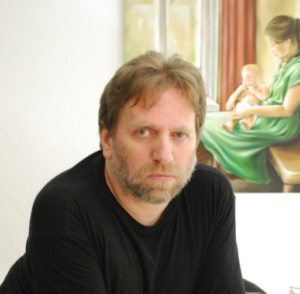 Michael K. Iwoleit was born in Düsseldorf in 1962 and lives in Wuppertal today. He was educated as a lab assistant and studied philosophy, sociology and German philology. Since 1989 he is a freelance writer, translator, editor and critic mostly in the science fiction field. Apart from his literary activities he has also worked as a copywriter for advertising and IT industry. He is the founder and editor of InterNova and was the co-founder and long-term fiction editor of its German sister magazine Nova. In the science fiction scene he is best-known for his novellas and for his essays about major short story writers in science fiction. His latest book is a reissue of his novel Der Moloch. His homepage is at mki.worldculturehub.net
Mike Mitchell, best known as a translator of classic and contemporary German literature to English, was for many years an academic with a  special interest in Austrian literature and culture, before he became a freelance literary translator in 1995. He has published ninety-nine translations from German and French, including Gustav Meyrink’s five novels and The Dedalus Book of Austrian Fantasy. His translation of Rosendorfer’s Letters Back to Ancient China won the 1998 Schlegel-Tieck Translation Prize. The translations that he generously permitted us to republish in this InterNova issue are from Franz Rottensteiner’s The Black Mirror and Other Stories: An Anthology of Science Fiction from Germany and Austria (Wesleyan University Press, 2008), his only foray into science fiction.