
by Özgür Hünel
“Now let’s examine the striking physical features of this ‘alien species’; A tall, slender neck, a head disproportionately large for the body, eyes without pupils, and a body that oscillates as if it had no fixed form and could change it at any moment. Isn’t it really an alien form? This 1919 portrait of Amedeo Modigliani’s greatest love, the young and beautiful Jeanne Hébuterne, may evoke a feeling of aesthetics and romanticism for many of you, and it is true. But in this lesson, we will learn to look deeper. Although it is aesthetics on the surface, there is another concept underlying it: Foreign intercultural interaction! Now let me explain you what this interaction is …”
When he got to this part, the monotonous voice of old Professor Ramin always reflected some excitement. Before starting this part, which he enjoyed telling, he wanted to adjust his glasses and took a quick glance around the class. The classroom was empty … After a while, he headed for the exit as if he were finishing a normal class. As he left, the classroom lights and holo systems were automatically turned off, and the floating portrait slowly disappeared.
Hold on, this is not happening right now … This is an old memory … This planet weakens my sense of reality, everything is colliding … I am very old … And my mind … I am so tired … I have to focus …
Ramin focused on the aliens in front of him—the native species of this planet, the “Speculoid.” Today was the first day of his class and he had decided to start with the art of painting; Although the Speculoids communicated telepathically, Ramin was using oral communication by habit and as they were still at the beginning of their communication, he thought that starting with a visual art would make things easier. With the holo-player on his arm, he showed many basic works, talked about movements, periods, masters. However, he was not there only to teach art; but to learn the concept of art in them as well. After all, it was an ‘exchange program’.
Does the golden ratio have an equivalent for them? The height of human is not coincidental; it was formed according to the Earth on which we evolved. The perception of perspective was formed according to height. Our concepts of big and small, aesthetic values, ratio and proportions are all specific to us, and in this context, unique to our world.
Speculoids, on the other hand, had a form that was constantly changing even though they were basically humanoid. Ramin had seen that their height can range from 30 cm to 4 meters. Such is the case, how could one talk about ideal proportions or aesthetics based on bodily form?
After Ramin finished his lecture, he turned to Jeanne, his guide –this was the name he had given to the Speculoid who was his guide on the planet simply because it reminded him of Modigliani’s portrait of Jeanne with her thin and long neck- and asked the Speculoids to show him what was their equivalent of the art of painting. The Speculoids communicated with each other and eventually told Ramin that they wanted to take him to the “northern light” so he could see and understand what he asked for. Ramin, too afraid, nervously refused, then left them and headed for his pod. His mind was starting to drift into the past again.
Jeanne is not just the name of a painting … Or the name I have given to my guide … There is another one. There should be another one…
Ramin and Jeanne met thanks to a strange incident that happened to Jeanne while they were studying art history in the same class. Whenever her teachers showed Modigliani’s portrait of Jeanne, bearing her name, in class, the girl fainted. Ramin thought he had figured out why.
When was this? Jeanne … Why was she passing out all the time? I’m having trouble remembering …
Ramin retired to his pod, stripped off his protective suit, and for the first time had the courage to pick up Jeanne’s diary and read it:
Jeanne’s Diary,
Lisbon, 2038
…My fainting mystery was solved by my new friend Ramin. In addition to the fact that fainting is only happening when I look at the portrait of Jeanne, he has uncovered it thanks to the expression of indescribable happiness on my face when I fainted. As he said, I suffer from a condition called “Stendhal syndrome.” It’s the first time I’ve heard of it, but it’s the syndrome of falling into unconsciousness when one is too impressed with a magnificent work of art…
… I chatted with Ramin for hours that day about that portrait. Since I can’t look at my namesake portrait because of my “condition,” just as Dorian Gray, the Oscar Wilde character, who couldn’t look at his own portrait, I asked Ramin to tell me everything he knew about that painting. For Ramin, the portrait of Jeanne symbolized intercultural interaction: At the beginning of the 20th century, European artists began to be inspired by African culture, and thus new schools of modern art, including cubism, emerged. For example, the slender and long necks in Modigliani’s paintings were inspired by African women’s lengthening their necks by wearing rings in accordance with their understanding of aesthetics. Ironically, western art was reaching new dimensions by taking its inspiration from the Dark Continent…
…At the end of the day, I could not help but ask myself: If intercultural interaction would work miracles, why do I succumb to inaction?
***
In the next lecture, Ramin talked about architecture. However, problems based on the difference between two species, the speculoids and humans, made his job more difficult. Architectural structures in the Earth were built with a variety of materials available to Earth, Earth-specific measurements, and most importantly, they were anthropocentric. Whereas the Speculoids basically always used the same material—a marble-white substance that looked like a mixture of glass and stone (hence the name “Speculum-Petram”, meaning “glass-stone” in Latin), and somehow, these structures were also in a state of change, like the people living in them! Ramin thought that structures moved in harmony with the movement of the planet, like the seasons, and the day-night cycle. But it was the job of other experts to uncover the secret of these stones and the technology they contained. Ramin, through Jeanne, had asked the Speculoids to share information regarding the design of their architecture with him, hoping that they would take him to a building or show sample images, but when the Speculoids tried to take him to the northern light again, he realized that he was wrong. Again, he had to decline the offer. He was beginning to think that he would return to Earth without learning anything from them. Moreover, his memory was getting weaker and weaker.
Jeanne was trying to persuade me … to go with her…
Ramin and Jeanne had their first quarrel when Jeanne decided to leave her education and go to the Middle East, the region where the Unification Wars blazed with all their violence. Jeanne wanted to join the volunteers there and help innocent civilians suffering in the war. No matter what Ramin said, he could not persuade her to stay, and he also turned down Jeanne’s offer to accompany her.
I should have stayed and finished my studies … I had responsibilities … Ah, come on, who am I kidding? I was just afraid …
Returning to his pod, he continued to read the diary:
Jeanne’s Diary:
Lisbon, 2041
… Ramin told me about another interesting topic today: Designer immigrations from Europe to the USA during World War II. The designers who fled the Nazi persecution made the USA their new home and not only lived the golden age of their careers in these foreign lands, but also paved the way to world-class schools that still stand today in graphic design and advertising. The spark in my brain with what Ramin talked about African influences turned into a fire after this conversation. I believe that “foreign cultures, foreign territories” are my destiny! …
… I decided to go to the Middle East, to the war zone. I’ve already contacted one of the voluntary charities. Of course, it was very difficult to explain to Ramin. Thanks to his Iranian origin, he knows the dangers of the Middle East. I know I broke his heart. But what I believe is true. People must follow their own path. What would he think if he knew it was something he told me that pushed me down this path? Can I be useful to humanity by standing here and studying art, or by helping the needy there?…
… I offered for him to come with me. But even quoting Picasso wasn’t enough to convince him:
“What do you think an artist is? An imbecile who only has eyes, if he is a painter, or ears if he is a musician? Far from it: He is also a political being, constantly aware of the heartbreaking, passionate, or delightful things that happen in the world, self-reflecting completely in their image.”
***
Ramin talked about literature and fiction in the following lessons, but fiction written by a human for other humans could only trigger something in the human mind and be effective; like a name that is uttered again and again, elements repeated within a certain pattern, or a layered narrative. He tried to play music, but while he was listening to Beethoven with contentment, towards the end of the piece, he realized that because of the difference in frequency range of their hearing, the Speculoids could not hear anything. Finding himself in a dilemma even with the most basic of art genres, he didn’t dare to consider discussing more modern and complex genres like comics and video games. Ramin had now admitted that he had failed. He was not sure that what he was telling them was understood by them, nor had he learned what art meant to them, because every time he was invited into that goddamn northern light, and he … He couldn’t go there.
This idea was wrong from the start. Ramin had come to believe that the concept of art was not universal but human-specific. It was kneaded with the Earth and the people on it, and it was born as the child of these two. It didn’t have to emerge in other civilizations.
To assume that a peculiar phenomenon is a universal value is just for a smug species like man.
By the end of that day, Ramin was back in the pod in frustration and anger.
I spent my childhood in the Middle East. I had seen enough for a lifetime, and I didn’t want any more. Was it God’s sense of humor that Jeanne wanted to go there, and moreover, wanted to take me with her?
It had been years since Jeanne had been gone, and Ramin hadn’t heard from her at all lately. Finally, his longing and curiosity for Jeanne overcame his fear, and he decided to go after her and find her.
Why did I wait so long to go look for Jeanne? Maybe if I had gone earlier …
He continued reading the diary, nearing the end:
Jeanne’s Diary,
Afghanistan, 2046
… Ramin and I chose different lives. He was happy there, I am happy here. And the more I helped people, the better I understood what the right decision was. Not only did I find my purpose in life and fulfill myself, but these foreign lands had also given me a life partner and a sweet little baby girl. It must be God’s sense of humor that Ramin came to find me just now…
… I could see from his face that he was disappointed when he saw that I was now a married woman with a child. I never doubted my choice, but he seemed to doubt his …
… He said he wanted to stay with me for a while as “just a friend” and help me. I agreed. I liked that he was a little bit idealistic and adventurous in the end. We spent days together, taking care of the wounded in the town, entertaining children and delivering food. He deftly concealed his fear until I warned him never to approach the north of town, where the bombs explode…
The diary ended here.
***
Ramin could barely read the last sentences. By the time he was finished, he fainted and collapsed to the ground. His mind couldn’t take it anymore because he had stayed on the planet for too long. He was about to lose all sense of time, and memories flooded his mind chaotically:
The year is 2112. I am 94 years old. When did I get this old? I’m lecturing in an empty classroom …
“Whatever happens, don’t go to the source of the northern light, Professor. We determined that that was the source of the magnetic anomaly. Possible effects on the human mind -”
A woman who says she is Jeanne’s daughter came to visit me. She was working on a government project called Serpo. She had heard a lot about me from her mother and asked me to take part in an alien exchange program? Aliens? What the heck is an exchange program? If it’s not technological nostalgia they’re looking for, what can we offer them?
“Never go outside your pod without a protective suit, professor. Your suit will bring the gravity to the level of the Earth, so you will be able to move comfortably. At the same time, the suit will purify oxygen, preventing you from contracting alien viruses.”
I am at Serpo facilities. They educate me about the planet I’m going to and about its people. I can’t say I’m very focused. I’m too old for this job. I overhear two employees talking. They didn’t care who was sent. An old man would suffice to say a word or two about art. Their only concern is the alien technology they will acquire through the exchange program.
“Project Serpo was an alien exchange program secretly run by the US government in the 1960s. It has been revised and reintroduced.”
I want to turn down the offer, but the woman leaves something on my table. It was Jeanne’s diary. She saved her best bet for last. She says that if her mother were alive, she would have asked me to accept this assignment. That I should have done this for her.
On the pod there is a relief inscription: “Made on earth by humans”
“The gold record attached to the Voyager spacecraft, which was launched into space in 1977, contained a lot of information about human civilization. The Speculoids somehow got the data. Only the artistic content caught their attention.”
***
Ramin was starting to come to his senses. He crawled towards the exit of the pod. He hadn’t even thought of putting on the protective suit. It was nighttime, and it was raining. Raindrops looked like brushstrokes on Van Gogh paintings. Gravity was greater than on Earth and the air was very cold. Ramin collapsed to the ground in agony. Light years from home, all alone, trapped in the fading memory of an old body.
“I couldn’t stop you from leaving. I didn’t come with you when you left. I was late when I was looking for you. I couldn’t save you when I found you. Besides, I was the one who made you leave in the first place,” he said, and finally he cried out, “It’s my fault! My fault!”
After a while, he saw a long-necked humanoid figure standing beside him. This was his guide, Jeanne, the Speculoid. Jeanne lifted him to his feet with her outstretched arms and held him tight so he wouldn’t fall. Ramin looked at Jeanne, trying to stop crying.
“Please, forgive me,” Ramin said in his struggling voice, “please.”
“I forgive you,” Jeanne replied.
One night in the rain a human and a Speculoid hugged each other tightly.
“I want to go to the northern light,” said Ramin determinedly, “I’m not afraid anymore.”
And they set off.
There was the sound of a child crying from the north of that town in Afghanistan. Jeanne couldn’t stand it anymore and rushed forward for help. Ramin could have run to stop her in time, but instead just shouted after her:
“You said not to go north. Bombs! Jeanne! Where are you going!?”
As Jeanne approached to the sound of crying, the last thing she saw was a suicide bomber standing over the child. What followed was a deafening explosion.
Ramin arrived at the source of the northern light with Jeanne. As he walked into the light, he seemed to hear Jeanne’s voice behind him saying, “Stay away from the north,” but he didn’t care.
Ramin had finally realized. The answer was: meaning.
Meaning does not manifest by itself in the universe; it must be manufactured. Life becomes meaningful only if one gives meaning to it. Art was the way to produce meaning for humans. And for them … It was this.
An indescribable happiness settled on his face as Ramin’s consciousness withered away forever. His last thought was:
“Stendhal syndrome … So this is how it feels.”
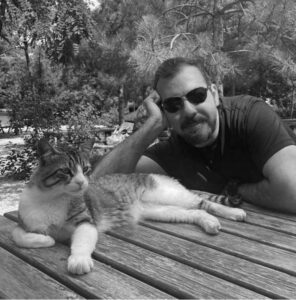
Özgür Hünel is from Ankara. He is an academic, graphic designer, and writer. He currently works as a lecturer in the Visual Communication Design Program at Başkent University. Alongside his academic work in graphic design and visual communication, Hünel is also interested in literature and writes short stories, particularly in the science fiction and fantasy genres. In 2018, he won first prize in the Science Fiction Short Story Competition organized by the Informatics Association of Turkey (TBD) with his story “Bilinmeyen Oran” (“In the Unknown Ratio”). His short stories have been published in anthologies in Turkey as well as in Italy, France, and Germany.