
by Ronald M. Hahn
Translated by Michael J. Berridge
There comes a day in the life of every man when he has to decide whether he will, in the future, stand in front of the bar or behind it. I was faced with this question on April 1, 1904, as I woke up with a throbbing head in a Leopoldville hotel room and remembered that I had finally run through the last of the gold nuggets I had washed out of the icy creeks of the North-West Territory. A letter from the hotel management lying on my bedside table acquainted me with the further fact that my presence was no longer valued. That naturally cheered me up no end!
I was about to button up my puttees when someone pushed another letter under the door.
Oho, I wondered, what can that be? An invitation to the Arctic hare hunt from Prince Woronzeff? A request that I partake in Lady Hamilton’s next gala dinner? A letter from the Chase Manhattan Bank, advising me that two friendly gentlemen are on their way to see me, for a little talk about the future of my overdraft? Or a handwritten note from the casino, to apprise me of the fact that I had been observed stealing a silver spoon?
It was none of these. The letter was from Japan and came from my old comrade-in-arms Jack, who was engaged in reporting the Russo-Japanese War for the Hearst yellow press.
“I’m just reading the new issue of the Flash Review,” said his hastily scrawled lines. “The publishers are going to make a go of it, all right. However, it seems to me they are making a number of mistakes.” (Here followed a list of all the improvements Jack was proposing in the Flash Review). “Visit the editors when you’re in London, won’t you,” his missive concluded. “But in Heaven’s name don’t let them know that the suggestions come from me. Offer them as your own! Otherwise these guys would make me their Far East correspondent – and that’s something I just can’t afford, not with the good rates I get. Above all, tell them to fire the dreary old bore who writes up the erotic literature… Tell them to get hold of a good-natured dummy who can report his view of the people who are hard at it.”
As nothing was keeping me in Leopoldville but my debts I resolved to turn words into action. A change of scenery seemed to me a prime requirement – and there was no extradition treaty between Britain and Belgium, either. England was just the place for me, in fact, even if I had never so much heard of the Flash Review before.
I got dressed, borrowed a handcart from a hotel porter, cleared my suite of the bottles which had been tending to accumulate, used the money back to pay the bill for the last four weeks and took the next steamship to London. On my arrival I took a cab to Soho, where the editorial offices of the Flash Review were housed. The company was located on Portobello Road, where it occupied six small back rooms, and was directed by Louie Lob and Herbie Hudel.
Herbie Hudel listened to my story with interest and accepted my suggestions without comment. He fired the dreary old bore who wrote up the erotic literature and, before I understood why he had been plying me one Scotch after another, I had signed a contract in which I committed myself to becoming his successor for the weekly sum of five shillings and sixpence.
Louie Lob, who then made an appearance, held out the prospect of a speedy increase in salary. An advance was unfortunately out of the question, my new bosses assured me, as the Flash Review had not yet turned a profit. But in three or four months’ time… And anyway: Were we not men of… er… Culture? Were we obliged to bow to Mammon?
The Flash Review, I learnt, was enjoying the attention of the London and Leipzig publishing houses to an ever-increasing degree. The advertising revenue would soon be enough to justify per-line rates for the freelancers. In the meanwhile, of course, I could keep the publisher’s copies and sell them off to a second-hand dealer.
Great!
Now that Lob & Hudel had found their good-natured dummy, I got to work straight away. What else could I have done? With neither cash nor lodgings, I could at least get warm on the Flash Review’s editorial premises.
Customers of the periodical for which I now worked included above all booksellers, libraries and those literary journals which could not afford a reviewer of their own. The last-named reprinted copiously from the Flash Review for a minimal fee. Booksellers and librarians picked up reading tips from us. Books which got a positive write-up in the Flash Review found their way onto the shelves more readily — and publishers naturally appreciated that. In the circumstances our staff were of course expected to deal generously with the titles that came in to us. Our motto was: Never upset an advertiser! But for a weathered press man like myself that was naturally the oldest of old hats.
I retreated to an unheated office, resisted the temptation to crib of the blurbs, and with a subtle thirstiness leafed through my predecessor’s files. It was obvious to me at once that he struck close to the text and generally avoided metaphors. An example of what the Flash Review expected of its staff was, I felt, provided by the review of a recent erotic novel by Lassie Brown, which I made a mental note of, and underlined three times.
“On Table and Bed,” I read, “by Lassie Brown. Pub. by Prick & Snatch Publications, London 1904. 256 pp., Cloth, 2/6.” And: “The central figures of this masterpiece of erotic literature, which the congenial young Whitechapel author, whose publishers never fail to take advertising space in our magazine, here presents, are three girls and a man. The girls are all young, sweet, eager and luscious. The first is slim and has medium-sized tits, the second is very well proportioned and has firm boobs, the third has gigantic tits and wears boots. The first girl has black stockings on without suspender straps, the second…”
As I began to impress the words of this gifted reviewer on my mind for the fourth time, the door flew open and Louie Lob stormed in. In his hand he was agitatedly waving a sheet of paper, which I had no difficulty in recognizing as a telegram form.
“At last,” he cried, “the Flash Review is receiving the recognition which it has long deserved!”
“Sir?” I inquired, irritated, for the perusal of the review had hardened my attitude in various ways.
“Get packing!” sang out Louie Lob. “You’re going to be a field reporter, my friend! You’re travelling into the Eifel!”
“To Old Germany!” trumpeted Herbie Hudel, who was hopping about like a dervish behind his colleague. “Ah, to see Old Heidelberg again — and eat sauerkraut!”
“Foreign correspondent?” I asked, as Lob and Hudel bundled me into a waiting cab. “But we’re a review service!”
“Who cares?” called Herbie Hudel, as the cab moved off. “When you get an exclusive engagement, you have to take it seriously! Don’t let us down, will you, young friend? The world will be clamouring for your report! Have you got a pen with you?”
And we were off. The cab took me to the docks and stopped in front of a decrepit sailing boat whose captain got me across the Channel in a few hours. Ignoring my frantic protests, he steered straight for the Belgian port of Ostend. Luckily the news from Leopoldville had not yet made the local papers. Collar turned up, hat jammed down over my eyes, I left the boat, climbed into a waiting coach and went through to Old Germany at top speed. As I was arguing the toss with the German customs officers over a mickey of Scotch, an elegant-looking gentleman with a monocle came up to us, laid into the officials with the abominable gutturals the Germans call a language, and gave them hell. The customs men groveled, grumbled and retreated.
My rescuer — that much was obvious — was of noble blood. And English, to my surprise.
“I am Lord Philip Loghead,” he said. “Have I the honour to…”
“No names, Sir,” I whispered with one eye on the Belgian officials lounging around in the vicinity. “But if you are awaiting the special correspondent of the Flash Review, then I’m your man.”
“Splendid,” said His Lordship, beckoning me into a further waiting coach. Soon we were thundering along a rough road southeast.
“Would you be so good,” I said, after studying my traveling-companion in silence a while. “As to inform me of the purpose of my visit, Sir? I must admit that my departure was somewhat abrupt… My superiors were in such a hurry…”
“Patience, patience,” said His Lordship. “Bear with me.” He was a man in his forties, with a weary look in his eyes. “Mr Lob and Mr Hudel could tell you nothing for the simple reason that they know nothing, my dear boy. What was your name again?”
“It is P.M. Fox, Your Grace,” I replied humbly.
“What does the P.M. stand for?” asked His Lordship.
“For Potiphar McGurgle, my Lord.” I blushed. His Lordship giggled, but I was used to that.
“The famous playboy?” Lord Philip raised his eyebrows. “Weren’t you the chap who took the Leopoldville casino…”
“You’ve heard the news?” I gulped. His Lordship had another giggle. Obviously, this prized upper-class twit read the Congolese press. It was really dumb though, the way I’d let myself in for the ULTIMATE GAME a day before my departure. Luckily nobody, in London at least, had learned that I’d had to leave the casino minus my shirt.
“You’re the talk of the town in Leopoldville, Mr. Fox,” said His Lordship. “But enough of that for now. I would like instead to prepare you for the man we are to be seeing. He has retreated into the Eifel hills to shake off these Russian spies the world is teeming with ever since gold was discovered in Alaska.”
“Aha,” I said, not understanding a word of it. “And how, may I ask, will he shake off the German spies?”
Lord Philip gave a hearty laugh. “Oh, they’re no threat to us! On the contrary. Ever since we have come under the personal protection of the Archduke Johann, they make sure that the others keep their distance.”
“Archduke Johann?” I asked. “The man who discovered the famous yodeller?”
“The very man! I see you have some appreciation of German culture.”
“Thank you very much,” I replied, flattered. “But… er, what I can’t quite understand, my Lord, is… er… why this… um… unusual man we are on our way to visit is under the protection of the German authorities. Was there no way to guarantee him the… er… protection of the British Crown?”
“Oh, but my dear Mr. Fox,” said His Lordship in a tone of mild reproof. “Do you know a single British secret that is not known to the rest of the world?” As I shrugged my shoulders uncertainly, he went on: “Well, there you are! Ever since these Bolsheviks have been laying waste London with their everlasting bombs and playing into the hands of the Russkies…” His Lordship shook his head. “A specter is haunting Europe! Just one word: Karl Marx!”
“Really?” I said. The coach took a bend and I bumped my head on something.
“Thanks to German thoroughness,” continued His Lordship. “We have been able to push ahead with our project unhindered up to the present time. Archduke Johann has graciously granted us the use of his hunting lodges. For that he gets a seventy per cent cut of the profits.”
I had to believe His Lordship, although I had not the slightest idea what he was on about. It was already pitch dark when we stopped a few hours later in the middle of nowhere, crossed seven slit trenches and picked our way through a minefield, and by this time it was clear to me that he must be working on a project of prepossessing importance. Wherever you looked the place was teeming with spike-helmeted, walrus-whiskered German soldiers. They frisked us right down to our underwear, then led us to a great house, whose windows had been boarded up and the boards nailed down.
The man who awaited us was a world-famous scientific genius, and I recognized him at first glance: Professor Peter Paul Phoney. The world said of him that he had withdrawn from public life, years ago, to finish his life’s work in complete seclusion. He was small, rotund, almost bald, and had a long white Rip Van Winkle beard, and a pince-nez enthroned on his bulbous nose gave him a learned and benevolent appearance.
Professor Phoney at once introduced me to the members of his establishment: Tom (tall, thin, pencil moustache, pronounced Adam’s apple), Dick (fat, short, awkward, projecting ears) and Harry (stubby, thickset, gloomy). The Professor’s left hand — assuming that Lord Philip was his right hand — seemed to be Captain Compart, a regular old warhorse. He had served long years in Her Majesty’s Royal Navy and still behaved as if he were commanding a crew of barefoot matelots. His voice had the volume and the tone of a foghorn, and he seemed to be a copious imbiber too, to judge from his red nose and the whisky on his breath.
“That would complete our party, then,” said professor Phoney with satisfaction. “And I consider it a particular honor, Sir,” he continued, turning to me. “That your newspaper has gone to the trouble of sending a special correspondent. That shows me that the quality press is very receptive to scientific matters.”
His Lordship cleared his throat.
Captain Compart grunted.
Tom, Dick and Harry stared at me.
I’d have been the last person in the world to have taken the Flash Review for a serious organ of journalism, but I was unwilling to contradict the Professor, particularly in the view of the high hopes my employers had of me. When a genius like Professor Phoney called for a journalist, weighty, world-shaking revelations were sure to be imminent. What could he have discovered? Was Ptolemy right after all? Did the sun go round the Earth? Was a world disaster imminent?
Whatever the Professor had to tell the world, it must be something big! It seemed strange to me that he’d chosen to invite the critic of a literary periodocal, but when all is said and done, one should have respect for the decisions of great scientists when one is only a raw layman oneself.
The Professor’s myopic gaze scanned me critically; then he asked: “Have you ever taken part in a research expedition before, Mr. Fox?”
“To be honest, sir,” I answered. “This is the first I have heard of your enterprise. I hope the goal of your expedition will not be the Belgian Congo, by any chance?”
The Professor seemed likely to split his sides laughing. Tom, Dick and Harry cackled. Lord Philip smirked. Only Captain Compart reacted differently. “If you ask me, we could have done without this press hack, Doc,” he said, glaring at me suspiciously. “We can always write the report ourselves.”
Professor Phoney’s laugh turned into an embarassed grimace. Then he stood up, smoothed his trousers, laid a hand on my shoulder and said in a fatherly tone of voice: “Follow me, young man. Come into the inner courtyard with me. I have something to show you.”
With the rest of the gang at my heels I followed him through seemingly never-ending corridors till we stopped before a heavy, hand-carved entrance. The Professor beckoned to Lord Philip, whereupon the latter beckoned to Captain Compart. Captain Compart indicated the entrance with his chin. Tom fished in his pocket, brought a large key to light and turned it in the lock. Dick and Harry opened the double doors.
I stepped over the threshold and blinked. In front of me, illuminated by a number of lamps, lay a long-stretched-out shape, vaguely reminiscent of a beached whale. It was about thirty yards long, cigar-shaped, rounded off like a huge grenade. The side facing me, to my amazement, included windows with the appearance of portholes.
“What is that?” I asked. “A submarine?”
Professor Phoney laughed. His Lordship giggled. Captain Compart groaned in the face of such stupidity.
“No,” said the Professor at length. “What you see here, young man, is the vehicle which Archduke Johann’s support has enabled us to build.”
“A vehicle?” I queried in surprise. “But it doesn’t even have wheels!”
“It needs no wheels,” went on the Professor nonchalantly, “because it is not designed for use on land. This vessel will speed through space. I call it a spaceship.”
“A spaceship?” I heard myself saying. “A spaceship?”
“We will be flying to the planet Mars in it tomorrow morning,” said the Professor gravely.
Of course I needed some time to take in the full import of this sentence. Professor Phoney and his team were going to fly to Mars! To another planet! Well, after all, I thought, why not? No-one has ever been there before. When the world learned of it, there would be great headlines for sure. No wonder my chiefs were so proud that one of their staff was going to be on board. A Times sub-editor with scientific training might have been more useful to the Professor — but as things were, the Wheel of Fortune had turned up my number. The Flash Review would make history — and I would be writing it! Already I saw myself — decorated with the Order of the Garter — shaking the hand of the Queen and swigging cocktails at Court. I’d pull in the fattest of correspondent’s fees, the world would be my oyster! I silently thanked my friend Jack, to whom I owed all this. He would be amazed when he read my spiffing articles after his return.
After we had drunk a drop to the success of the expedition, I shook the Professor’s hand and said: “Sir, I’m your man. Gentlemen, I am at your disposal.”
“I thank you,” said the Professor with feeling and clasped me to his breast. Lord Philip returned my determined handshake. Tom, Dick and Harry were somewhat more reticent. Only Captain Compart showed his feelings openly. “Go to the devil — tanks to you, I can only take one cask with me now,” was his only comment, as I endeavoured to make a good companion out of him.
The Professor explained that our journey would last twelve months. We were well prepared: the spacehsip’s hold was full of salt pork and ship’s biscuit. Apart from that, nothing had been overlooked. Lord Philip had a case of French champagne for festive occasions, the Professor was taking a box of Havana cigars, and Captain Compart had brought a cask of Old Scotch on board with him. After Archduke Johann’s men had shot us into space with a huge catapult, we took our places in the drawing room of the spaceship and drank to one another’s health.
So far everything was running to plan. The Earth grew smaller and smaller, and soon it was possible to take in Europe and Asia at a glance. I thumbed my nose at my creditors in Leopoldville and commenced my journal. Needless to say, my sparkling wit would take the literary world by storm; of that I was determined. The reader should not merely be instructed by our discoveries; he should delight the richness of vocabulary with which Mother Nature had endowed me. Anyway, I was thinking of having my yet-to-be-written articles issued in book form as well. William Blackie and his Sons would certainly be mad keen to get my adventure into the bestseller lists.
While the Professor remained on the bridge, adjusting the controls, Captain Compart supervised the ship’s crew. Tom, Dick and Harry, I now realized, were not the scientific assistants of the brilliant Professor, just plain servants whose job it was to scrub the deck und keep the galley shipshape.
On the third day of our voyage — with the Earth now no more than a cloud-capped ball — I noticed that Harry was prone to insubordination; no sooner had Captain Compart given him an order than he stuck out his tongue at him behind his back. Tom and Dick, while less recalcitrant, were lazy, greedy fellows. As time went on, they made a more and more doubtful impression on me. Then they revealed their true character: after two weeks they were stealing the Professor’s cigars, getting drunk and giving me insolent answers when I asked them to make less of a row.
Lord Philip seemed particularly irritated by their conduct. “All this is a consequence of the growth of civil rights,” he said indignantly when addressed on the subject. “One has only to grant this rabble a break from work, and the next thing is they’re asking for vacations!” And when pushed further, he would say: “In my brother-in-law’s textile factories there used to be none of this. The people put in eighteen hours’ work a day and had no complaints. What this scum needs is a good horsewhipping!”
“Quite right, my Lord,” agreed Captain Compart. “This riff-raff doesn’t even respect my Scotch anymore. But these blackguards know that we are dependent on them for the moment. That explains their rank disobedience.”
“Dependent?” snorted His Lordship. “The servant has yet to be born wo makes a Loghead dependent on him! Why not simply dismiss these proles and replace them with others?”
“Because,” said Captain Compart. “We are over ten thousand miles from England, if I may be permitted this observation. With respect, my Lord, we really cannot change the crew at present.”
“Very well, then,” said His Lordship and scratched his ear. “But at the next port these good-for-nothings get a regular whipping.”
I kept my journal. There being very little to see in space outside, it didn’t fill up very quickly. Every time I looked out of the portholes I saw the same thing: just stars and darkness, darkness and stars. The same old stuff you can see from the Earth. As time went by it was really getting to be a bore.
When after six weeks the cigars and whisky ran out, people began to get nervous. His Lordship ran up and down like an angry tiger, Captain Compart displayed severe withdrawal symptoms and rapidly fell to pieces. The crew, who observed this with malicious delight, soon lost all remaining fear of him and took filtering aftershave through slices of bread to at least get a nightcap now and then. When Captain Compart gave them an order, he got replies such as “Do it yourself, you lazy pig,” or “Go to blazes, you capitalist lackey,” or “Take it easy, mate, or you’ll get a punch up the conk.”
As manners on board visibly coarsened, it was of course only to be expected that Professor Phoney, who hitherto had devoted himself to his scientific studies, would get a swiff of things. In the eight weeks of our voyage he stormed into the ship’s library one day in a towering rage — His Lordship was reading Chaucer, I was writing my journal — and said in a voice of high-pitched indignation: “This, gentlemen, is going too far! I have just tripped over an empty whisky bottle! The crew’s quarters, into which I tumbled, look like a pigsty! And Captain Compart lies on his bunk daydreaming! When I spoke to him, he had nothing to say but ‘Well, go and lie down again.’” Professor Phoney gasped for breath and added, beard bristling: “It seems almost as if this spaceship’s complement lacks the slightest respect for the exalted goals of science.”
“Sir…” I said, if only to say something.
“Hold your tongue!” thundered the Professor, quaking with wrath. “What condition will we be in at the end of our voyage, if morale is up the spout only eight weeks after departure? Do something, and I mean now!”
“Right you are, Sir!” I cried, standing to attention.
“You will take over Captain Compart’s duties at once, Fox! You know very well what you have to do!” Growled the Professor.
“Right you are, Sir!” I trumpeted. “But won’t Captain Compart be put out if I…”
“I don’t give a damn about that!” said the Professor, blithely disregarding the fact that in general he considered arguments of this kind to be unscientific. “Order is to be restored at all costs!”
I sighed, gave His Lordship a nod, strapped on two pistols and headed for the crew’s quarters.
I would have done better to remain seated, for scarcely was I in the corridor than our trusty craft begann to lurch violently, turned somersault and — sank. That is, I had the feeling that it sank. I sank, in any event — to the floor. As I came round again, all alarm bells were ringing and someone was shouting: “All hands into the boats! Women and children first!”
I must say, I found that very curious indeed. “We have collided with an asteroid,” sighed the Professor in agitation. “All is lost! We are going to crash! Captain Compart! Captain Compart!”
Captain Compart came staggering out of his cabin. He was unshaven, hung over and looking pretty pathetic — as always. Something in his face reminded me of a WANTED poster I had seen in Casablanca not long ago.
“Wassamatter, huh?” he asked, fastening his braces.
“We must at all costs avoid panic!” screamed His Lordship, foaming at the mouth. “Calm down, Mr. Fox, for Heaven’s sake! Do calm down, will you! Just pull yourself together!”
“Me?” I asked, shaking him off. It went Scrunch again, then I was flat on my face for the second time.
“Ground contact!” reported Tom. “We’ve made a crash landing!”
I must confess that at this moment I felt my resolve rapidly ebbing away. We had set out to turn one of mankind’s bold dreams into reality. But instead of planting the banner of Archduke Johann in the sandy red desert of our neighbour planet and deciphering the secrets of its canals, we were grounded on a miserable pock-marked lump of rock hurtling through space.
While Lord Philip — who happily had broken my fall somewhat — moaned and groaned underneath me, Tom bellowed from the bridge: “There! There! There! I’ve seen movement! Professor! Professor!”
“Brothers in the cosmos!” crowed Professor Phoney, as he got up off the floor. “We are not alone in the universe! Open the hatch! Let us greet them!”
I stood up, helped His Lordship to his feet and hurried to the exit. Tom, Dick and Harry were just sliding back the huge bolt. Captain Compart was wrestling with his braces. The overjoyed Professor was hopping excitedly from one leg to the other and lapsing into Latin in view of the epoch-making nature of the occasion. No sooner was the hatch open than he jammed a top hat onto his head and sprang out.
“Take care!” I cried. “The natives might not be friendly…”
Professor Phoney went back. A feathered arrow hat pierced his hat. His face was white. His chin trembled with anguish. “They are savages!” he cried. “They shot at me! Me, a man of science!”
Ping! Ping! Ping! A whole salvo of arrows whistled through the open hatch and buried themselves in the corridor wall.
“Close the bulkheads!” roared Captain Compart. “Give them a broadside! Where is the infantry?”
It was obvious to me at once that he had taken leave of his senses. Lord Philip, pushing the Captain aside, called out in a nasal tone: “Must British gentlemen put up with such a reception? Are we so far gone that we allow our honour to be called into question by a few naked savages come up out of nowhere? It is high time we gave these iconoclasts a sound beating!”
“Steady on, Your Grace,” I soothed the heated nobleman. “First we must work out a plan.”
While Tom, Dick and Harry guarded the way out, grappling irons in hand, the rest of us retreated into the drawing room.
Professor Phoney, looking grim, turned his pierced hat around in his hands and mouthed dark curses. Evidently, he had expected his welcome to another planet to be different. Finally, however, he shrugged his shoulders and put his headgear back on.
“We must summon the British army at once,” said His Lordship with some heat. “If necessary, the Scottish Higlanders too!”
“Scotch?” asked Captain Compart with interest. He lay in his armchair like a sack of potatoes, greedily licking his lips.
“This just will not do!” I made myself heard above the babble of voices. “Gentlemen! We can expect no military aid of any kind!” No-one paid attention to me. “How does the poet put it?” I went on at the top of my voice. “God helps those who help themselves! We must take our destiny in both hands!”
“He has persuaded me,” shouted His Lordship and grasped my hands in gratitude. “What have you in mind to do?”
“A most stirring speech, indeed,” confessed the Professor with emotion. “You can evidently do more than just eat sandwiches, my young friend. What do you propose?”
“Well… er… First, we should find out who our opponents are.”
“We should indeed,” agreed His Lordship. “Otherwise, it might yet occur to the enemy that he should come in here to find out who we are.”
Professor Phoney made a pensive face. “I wonder,” he said, “If these savages are controlled by a corrupt medicine man and induced to attack us by a false presentation of the facts. Perhaps they are friendly toward us at heart.”
“May I ask,” interposed His Lordship. “What led you to this interesting theory, my dear chap?”
“Yes, well,” replied the Professor with embarrassment. “Well then, to be honest with you… this theory isn’t one of mine. I have taken it from the… er… secondary literature. Such phenomena are a common occurrence, for instance, in the South American and African bush — evil witch doctors going over the head of the wise chieftain and inciting friendly tribes against the white men, I mean.”
To know more, we went to the next porthole and looked out. Our spaceship had landed on a plain dotted with sparse vegetation. In the background were a few decorative crimson hills. Over the sandy ground that surrounded us were scattered a number of great glittering stones. I took them for shards of glass at first, but Lord Philip, who obviously had better eyesight, cried out suddenly: “Enormous diamonds! And they are just lying around out there!”
“Diamonds?” echoed Professor Phoney. His little eyes grew as big as soup plates, and he polished his pincenez lenses eagerly.
“Diamonds?” gurgled Captain Compart in disappointment. “No Scotch?”
“Gentlemen…” I began.
And then I saw one of the savages. He looked like a walking carrot with green skin and four arms and a flat beaver tail. A round mouth with one gleaming fang glowered at me. Professor Phoney said: “He too is one of God’s creatures!”
“And what do we do now?” asked Captain Compart in one of his few lucid moments.
“Yes,” said His Lordship. “What do we do now to get at the diamonds?”
“Sir!” intervened Professor Phoney, his voice quavering with indignation. “You have evidently forgotten the reason for which we undertook this voyage! It is our intention to return home with scientific data. There was no mention of diamonds! We …”
“Originally we were bound for Mars, were we not?” commented Lord Philip. “Are we on Mars? Well, then! What can be the objection to our taking a few rough diamonds back home with us, now that we are here?”
“Gentlemen …” I ventured.
“These diamonds,” lectured Professor Phoney. “Belong to the indigenous population of this asteroid and …”
“But these savages obviously have no idea of the value of this jewellery! For them the diamonds are presumably as worthless as flint!”
“Gentlemen …” I began once more.
“Did I hear someone say ‘Diamonds?’’’ Inquired Tom, Dick and Harry all of a sudden. They were standing in the doorway, gripping irons in their hands. Captain Compart sucked his right thumb. Lord Philip blenched with fright.
“I cannot imagine what that has to do with you,” retorted Professor Phoney undeterred. “I order you to return at once to your…”
“You don’t order nothing,” said Tom, Dick and Harry as if with one voice. “We’re taking command now — understand?” The sight of their grapnels drove me back.
“Is this mutiny?” asked the Professor, beside himself.
“Just what I always said,” fumed His Lordship. “All of these insolent proles should be given a thorough beating, to teach them who…”
Captain Compart bleated like a lamb. The withdrawal symptoms were taking their toll of him. No further help could be expected from him, that much was clear.
I drew in my stomach, whipped out both pistols and snarled: “Back to work, you miserable curs! There will be no mutiny here as long as one of us draws breath!”
Tom, Dick and Harry retreated. Had I not fled Leopoldville to be held to ransom a million miles from Earth by a few lousy space sailors?
Soon after that, a suspicious squeaking made itself heard. Lord Philip ducked and the Professor dived behind the sofa. I went out with Captain Compart, who was laughing hysterically, and found that the crew had disappeared. Despite the bloodthirsty savages who lay in wait for us, they had abandoned ship. My shooting irons must really have given them quite a fright.
The hatch was open. Had the savages made short work of the mutineers? Would we all meet our end at the stake before long? I plucked up courage and looked out. Nobody was to be seen. The footprints of Tom, Dick and Harry ended at a cucumber copse, which rose some fifty Yards to the south of us. Where were the savages? Had they withdrawn elsewhere? Patience, then, was not one of their virtues.
When I left the ship, nothing happened. My courage revived. It was a strange feeling, walking over the surface of another heavenly body. Everything was as on Earth — except for the funny plants and the giant diamonds, of course. I was soon followed by Captain Compart, the Professor and His Lordship. As no-one challenged us, our gloomy mood began to clear, and soon we were investigating the glittering rocks. They were bigger than ostrich eggs and weighed several pounds.
“We’re rich!” carolled Lord Philip, stuffing his pockets full. “Rich! Rich! Unimaginably rich! Yuk! Yuk!”
Professor Phoney, as a man of pure science, followed the nobleman’s doings with a jaundiced eye. Captain Compart tried to crack open the diamonds with hammer and chisel, obviously under the illusion they were bottles.
“This is the end, Professor,” I said, after watching the activities of the other two for a while in silence. “The crew has absconded — and His Lordship and Captain Compart have gone mad. How can we hope to reach England again with things like this?”
The Professor sighed. “And with these savages lying in wait for us somewhere,” he said mournfully. “I, too, am gradually coming to the conclusion that our expedition has not been blessed with success, young friend.” He frowned, seeing His Lordship dash back into the spaceship to look for a wheelbarrow. Captain Compart sucked at a big fat diamond and burst into tears.
And then the savages sprang up all around us, literally out of the ground. They had lured us into a trap — by secretly burying themselves in the sand.
#
“Goddamned son-of-a-bitch!” I said, as I came round again, my hands bound, in a sort of tent. My head began to hum merrily, reminding me of that lovely hotel room in Leopoldville, where everything had started.
“I would not have thought that the special scientific correspondents of the Times were proficient in such vulgar language,” observed Professor Phoney, who lay beside me. “I am really most surprised, Mr. Fox.”
“Excuse me, Sir,” I replied, seeking to penetrate the darkness with my gaze, “But I am neither a scientific correspondent, nor do I write for the Times. May I inquire what gives you the idea?”
“I beg your pardon?” asked the Professor, gruffly astonished. “How … what … where …”
“I am a literary critic,” I said. “With the Flash Review in London. Lob & Hudel Press, if the name rings a bell.”
“What — you work for that lascivious paper?” The Professor nearly choked on his indignation. “That can’t be true! Lord Philip, what have you to say to this? Did I not instruct you to ask that a scientific correspondent of the Times …”
“His Lordship is not here,” said Tom, his voice coming from the darkness.
“But we’re here,” said Dick.
“Tom, Dick and Harry,” said Harry.
Captain Compart was also with us, which became clear in the form of a number of muffled grunts. The captain was lying on his face in the sand. Serve him right, the old soak.
“Now this is really quite beyond me,” said Professor Phoney. “Can you explain that Mr. Fox? Why did Lord Philip take you on when I expressly… Do you think it possible that he mistook you for someone else?”
“Scarcely, Sir,” I answered. “His Lordship specifically mentioned the name of my publishers. And as the publishers of the Times are not called Lob & Hudel…” I shrugged my shoulders in regret.
“Omigawd!” groaned the aged academic. “Now I understand! Lord Philip is a Russian Spy! He wanted, at all costs, to stop another scientist in our party — someone else who could transmit certain research findings, apart from me! That is why he took you — a reviewer!”
“His Lordship a Russian spy?” The thought of that made my hair stand on end. “But that’s impossible, Professor! I know no-one who hates the Reds more than he does!”
“That’s only logical,” said the Professor. “After all, if he is an agent, he will of course be working for the Czar. And his noble blood is attested to by his observations on the working class.”
“That could just be a cover,” I objected. But I had to admit, that there was something in the Professor’s theory.
Now it was Tom, Dick and Harry’s turn to speak.
“The savages surrounded us as soon as we tried to look at the diamonds,” wailed Tom. “Are they going to roast us now, do you think?”
“You are a chump,” interjected Dick. “Foreigners have quite different customs than us!”
“But they had such a hungry look in their eyes,” whimpered Tom and wrenched his hands. “I’m scared.”
“Scotch?” murmured Captain Compart.
“Since they appear to be descended from carrots,” murmured Professor Phoney reflectively. “They are in all probability vegetarians… but that in turn would mean that they are cannibals… Vegetarian cannibals — or cannibalistic vegeterians…”
“We must keep cool heads now,” I said. “If we panic now, all is lost… SHRIEK!”
Something cold had touched my hands from behind. A soft voice went “Pshshshttt!” The others turned their heads, but otherwise did nothing. Even Captain Compart woke up.
Someone was working on the knots that bound me.
“Lord Philip?” I asked softly. “Is that you?”
“Par bleu,” hissed the voice. “…’old still, Monsieur! Voilà!”
Suddenly I was free, rubbed my stiff limbs and stood up. Our rescuer seemed to be a Frenchman. Or a Belgian. But how the deuce did he come to be here? Had the French invented a spaceship as well? Had His Lordship met French explorers and joined with them to free us? Or was Lord Philip actually a French spy?
Questions, questions. The stranger evidently slit open the tent with a knife from outside. Now he slipped from one to another.
“Who are you?” I asked him, after we had crawled into the open. “Where are you from? Have you met Lord Philip?”
“I am ze chief of zees tribe, M’sieur,” replied the foreigner. “May I eentroduce myself? Théophile Francois DuBois de Bologne. Vairy pleased to make your acquaintahnce.” We shook hands. “Come in my hut. I weel explain you evvraithing.”
Without a word we hurried along behind him and finally arrived at a reed hut in the centre of the village consisting of about a hundred tents. Soon afterwards we found ourselves in a room floored with straw matting. Carved figures of demons grinned down at us from the walls, giving one cold shivers down the back. Tom, Dick and Harry were green about the gills with fright. We sat down at an open fire. DuBois de Bologne offered us food and drink. As far as Tom, Dick and Harry were concerned, their gluttony seemed to be greater than their fear; they helped themselves at once and stuffed themselves full. The Professor and I were too perturbed to take anything. Captain Compart raised an earthenware jug to his lips to quench his blazing thirst, but as it contained nothing but water, he spewed it out, fell over and snored on.
DuBois de Bologne was a gaunt, bearded man with dark hair, a greasy-looking beret and numerous scars. His clothing consisted of a mangy skin and down-at-heel parade boots. On Earth he had worked as an agent for the Sureté, and after we had told him of our adventures, he said: “A similar fate drove me here.” And this — in brief — is his story: Two years earlier, an American inventor was able to convince the French government that he could build them a spaceship. As there seemed to be a good prospect of extending the French colonial empire in this way, the project got the go-ahead. However, the American and his people were not really trusted and so our rescuer was put into them. “We didn’t reach ze planet Mars any more than you did, gentlemen,” concluded DuBois de Bologne. “When we made our forced landing ‘ere, all ze Americans were killed. Luckilee I was in ze hummock at ze time, so I survived ze crash un’armed.”
“And how did you manage to take over the chieftainship of these barbarian savages, Monsieur de Bouillon?” asked Professor Phoney with interest.
“First of all I ‘ad to conquer the old chief, of course,” our rescuer continued. “But that was easy; I was able to buy ze crafty medicine man’s favour with a ‘andful of glass beads.” Monsieur DuBois de Bologne shrugged his shoulders. “Later, though, this rascal turned against me, because I would not marry his seven daughters. At zees moment a campaign of character assassination is being waged against me, the outcome of which is a foregone conclusion.”
“How frightful,” commiserated Professor Phoney. “But why did you not want to marry the medicine man’s daughters? Are they that ugly?”
“When one is the only ‘uman being among a lot of walking carrots,” answered DuBois de Bologne. “One naturally lowers one’s expectations in the course of time, but… No, his daughters really aren’t ugly. But they refused to wear the lacy French underwear I ‘ad in mind for them.”
“I see,” said Professor Phoney and blushed.
“You can surely imagine ‘ow ‘appy I was when I ‘eard of your arrival,” continued the Frenchman. “We had better move from ‘ere soon, because when Umazuma — that’s ze name of ze old scoundrel — learns of your escape, he’ll be shouting blue murder. And then Lullu — er, I mean, God help us,”
That made sense. But how could we get back to our spaceship undetected? And — a particularly ticklish question — how could we deal with the Czarist spy who was posing as Lord Philip? We had to assume that he planned to divert our landing to St. Petersburg; after all, he couldn’t have just come along for his health.
We quickly initiated our rescuer into our interpersonal problems — and did not forget to point out that Tom, Dick and Harry represented three more doubtful quantities on board.
“That we can take care of relatively quickly,” said DuBois de Bologne and produced a long, jagged-edged knife. “We’re all in zees together. Cut up rough and you get cut up rough. One for all and all for one. Okay?”
Tom, Dick and Harry nodded hurriedly, and I asked myself if the Frenchman could be of noble blood too. We left his hut and headed north with a crazily babbling Captain Compart in our wake. Soon we were standing before the whale-like body of our spaceship, whose portholes were completely dark. The hatch was shut, of Lord Philip there was no trace. We rattled away, but with no effect. Either His Lordship had gone to bed, or he was no longer alive.
“By the seventh ‘ell of Killiwatch!” cursed our new travelling-companion. “Is there no other way to get into zees vessel?”
None of us was feeling particularly cheerful, for the thought that the sun could rise at any moment did nothing to brighten our spirits.
“Your Lordship!” roared Professor Phoney. “May I remind you that I am the designer of this spaceship! Without our aid you will never be able to leave this inhospitable place! I appeal… Oh! Oh, gosh!”
The check to his fury was due to the fact that the sun was now peaking over the horizon, allowing us to make out a few dozen screeching carrots in the light of its warming rays. They were on our track, tongues hanging out.
“In Heaven’s name, Lord Philip, open up!” I screamed in desperation. “The savages are coming! Think of your duties as a Christian!”
Tom, Dick and Harry began to wail. The Professor hammered on the hatch with his little fists and let out a few unsavoury imprecations. I had honestly not expected such behaviour from a man of learning.
The savages were now within a thousand yards of us. They grunted, yelled, roared, whistled and howled like a pack of bloodhounds and bared their fangs in such a way as to inspire fear and trembling. Tom, Dick and Harry, teeth chattering, were praying out loud. Captain Compart sang Rule Britannia, but as I doubt if he even saw what threatened us, I can only assume this to have been a reaction to his withdrawal symptoms.
“We’re breaking the hatch down!” I shouted in blind panic and took a run at it. Crack! Then I was lying in the sand, stars gently revolving before my eyes. My shoulder hurt like hell. At that moment I cursed not only Louie Lob and Herbie Hudel, but my old friend Jack as well, who was sure to be squatting in his Japanese trench peacefully photographing Russian grenades as they came whistling through the air.
And then Professor Phoney had his bright idea.
“What is this?” he suddenly shrieked so loudly that I thought my eardrums would burst. “Jumping Jehoshaphat! The savages have rifles! But what do I see? They aren’t savages at all! They’re men in uniform! Soldiers with…” He paused as if to rally from a fearsome blow and then screamed in sheer panic: “…with Russian uniforms!”
Ha, ha! Of course this Czarist spy fell for it hook, line and sinker. With a hoarse cry of joy he tore the hatch open and yelled: “Druzhba! Druzhba!”
Monsieur DuBois de Bologne socked him a straight left to the jaw, shouting “Allez! Allez!”, scythed the air with his jagged bread-knife and dragged his senseless victim after him by the collar. In a matter of seconds we had entered the spaceship, secured the heavy bolt and hurried to the bridge, where Professor Phoney flew at the controls.
Through the portholes we could see the barbarian carrots, howling and slavering, surround our fortress. They pelted us with massive diamonds and called down vampires and monsters upon our heads. Monsieur DuBois de Bologne showed me the medicine man Umazuma. He stood on a hillock — surrounded by his seven daughters with their carrot tops — und hurled furious threats at us. A hail auf arrows rustled against the outer skin of our vessel. When the infuriated carrots began carting up firewood I had visions of the worst, but then came a call from Professor Phoney: “We’re starting, gentlemen! We have lift-off!”
I suppose everyone can imagine how relieved we were at that moment. Tom, Dick and Harry fell on one another’s necks in brotherly side hugs. DuBois de Bologne and I slapped one another on the shoulder. Captain Compart, who now seemed to think he was a hen, cackled and did his best to peck at the grains of sand we had brought in on the soles of our boots.
“Don’t be surprised, Monsieur,” said I to DuBois de Bologne with an embarassed smile. “Captain Compart hasn’t gone off his rocker. He’s English, you know!”
“Oui, oui“, nodded the Frenchman. “That is his spleen, nést-ce pas?”
#
I assume the account of our return to Earth is common knowledge. It was a sensation for the world press; after all it isn’t every day that a spaceship lands at the Christmas fair in Munich unannounced. A Salvation Army brass band, who happened to be there at the time, played “Nearer, my God, to Thee” as we goose-stepped off our craft. Although the area was blocked off at once by a platoon of spiked helmets, not even they could keep Captain Compart from helping himself to what he had had to do without for so long. However, our backer, Archduke Johann, proved generous enough to pick up the tab for the twelve litres of Glühwein — and the hospital bill for the stallholder, who had been under the false impression that he was strong enough to keep off the babbling beast hopping round his merchandise.
We were sealed off in a hotel suite. Archduke Johann’s men removed the spaceship. We rested up for a few days, put our reminiscences on paper and at last discovered that Lord Philip Loghead (the name was of course false) really did work for the Czarist secret service. The Russians too were working on a spaceship. Starting shortly after us, they were to have thrown us in irons on Mars with the help of their agent, so that neither Archduke Johann nor the British Crown should learn that we had reached our target. Unfortunately, the Czarist spaceship had gone down over Knatterottopovsk; of the crew there was no trace.
In the meantime, the asteroid we found DuBois de Bologne on had been located in space: it was called Bellus. Archduke Johann was not particularly happy about the Passenger we had brought back with us (because he provided the proof that the French had sole right of colonization), but — as he was an aristocrat — his noble heart came to terms with it in the end.
Professor Phoney was commissioned to improve his spaceship and set out as soon as possible on a second expedition to Mars. Tom, Dick and Harry received thirty lashed apiece with the cat o’ nine tails and were exiled to Togo.
After taking my farewell of DuBois de Bologne, I travelled to London, to report to my publishers. Following my long stay in space I was still rather unsteady on my legs, as I came up the Portobello Road in a cab, and so it was not to be wondered at that a fit of giddiness shortly after caused me to collapse on the editorial sofa. Louie Lob and Herbie Hudel poured a three-decker Scotch into me and enthusiastically related how the prior announcement of my hair-raising adventures had raised the Flash Review’s circulation tenfold. The whole of Fleet Street was green with envy, they reported, and the board of management of the Times were seriously considering the prospect of financial involvement in Lob & Hudel Press. In fact, my chiefs went on, they were currently wondering if the Flash Review should not somehow change its concept and publish thrilling travel tales rather than literary reviews.
The two of them had made a string of plans for me. My next exploit was to be a trip in a submarine, then I was to join an expedition to climb Nanga Parbat, track down the headhunters of Borneo, run the Loch Ness monster to Earth, and (last but not least) travel to South America with a certain Professor Challenger to find a hidden valley where prehistoric dinosaurs were said to live still.
Before I could put two words together Lob & Hudel had fed me another triple-decker, pronounced me the greatest reporter since the late lamented Rudy Hirtpichler, raised my pay to 6s 2d, introduced me to the chairwoman, acquainted me with all the messenger boys, and led me back to my worm-eaten old desk, where four months’ work had been piling up waiting for me.
The Flash Review really did develop into a bog topical newsmagazine. The title was changed of course; now it was called Lob & Hudel’s Flash Report and was written by the best-known sensationalist reporters in the world.
My series on Professor Phoney and the discovery of the asteroid Bellus was a rip-roaring success. It was syndicated in all leading European newspapers, and old Hearst picked it up for his papers too. D.W. Griffith canvassed for the motion picture rights, and the book that eventually came out, ran to 34.8 million copies worldwide (translations and book club editions included).
France founded a new colony on Bellus. The Foreign Legion sent the savages into reservations; holy men brought them the word of God. Before long they had forgotten their idol Lullu.
When the first French space fleet returned from Bellus with huge shipments of diamonds, I was naturally in trouble. As we had completely forgotten to tell our financial backer Archduke Johann about the diamond finds, he sent out a murder squad that liquidated Tom, Dick and Harry in Togo, drove Captain Compart into the Foreign Legion and forced Professor Phoney to take a position as museum attendant in Dar-es-Salaam. As I was financially independent, thanks to the millions I had accumulated, I did a midnight flight, took ship for Tierra del Fuego and bought a big estate there.
Unfortunately stock prices soon began to fall as a result of the diamond glut, and the companies in which I had invested (the Bank of America and Honest Hank’s Used Cars) went bust.
Today I live on the Moluccas as a representative for kitty litter, but I have no doubt that the day will come when great new adventures will summon me to action.
Originally published as “Hey, Mr. Spaceman!” in:
Ronald M. Hahn Ein Dutzend H-Bomben, Ullstein, 1983
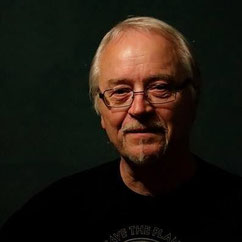 Ronald M. Hahn was born in 1948 in Wuppertal where he still lives. Initially a typesetter, he set out in the early 1970ies on a prolific career as writer, journalist, translator, editor and literary agent inside and outside of the science fiction field. He was editor of the groundbreaking book series Fischer Orbit from 1972 to 1974 and editor of Ullstein Science Fiction from 1982 to 1988. He compiled the German edition of the The Magazine of Fantasy and Science Fiction until 2000. In 2002 he founded in collaboration with Helmuth W. Mommers and Michael K. Iwoleit the science fiction magazin Nova and remained its co-editor until 2011. Outside of the science fiction field he gained some popularity with his film encyclopaedias (many in collaboration with Volker Jansen) and his youth books, the latter mostly with Hans Joachim Alpers. His stories have been translated into more then ten languages and his fiction and nonfiction was awarded with the Kurd Lasswitz Preis seven times and with the Deutscher Fantasy Preis (German Fantasy Award) once.
Translator Michael J. Berridge was born in London-Wembley and lived for many years in Canada and in Wuppertal, Germany. He worked as a nonfiction translator (mostly of court documents), but also as a scout, specialized in German musicians, for the British music company EMI.