
by Tolga Aydin
All of this is a confession of my own depravity. Unfortunately, this is not one of those ballads that end with a reunion powerful enough to pierce mountains and dry up tear ducts. Writers as bad as I am are only capable of confessions. At least this one has a relatively decent ending. If you ask my father — or twelve billion other beings — happy would never even cross their minds.
Speaking of my father …
Whenever I came home beaten up from the street, he would fly into a rage. He was short but broad, a thickset, powerful man. He sincerely believed that fear could only be dulled by violence. One time, when I came home with a split lip and sat down at the silent dinner table to ask for the soup I expected, he stopped my mother. I told them I had sent two kids to the hospital and only slightly scratched by them. He pressed a spoonful of hot soup into my palm and said it was better for me to be beaten by girls than to hear a lie from his son. That night, as I slept hungry on my grandmother’s couch reeking of black cabbage, his lecture echoed in my ears: “We’re not made to be the best. I want you to be strong. A man is only that much. One day you’ll thank me for it.”
I was twenty-one the first time I smashed a someone’s face in. He was originally an amphibian from the Koza Nebula, all head and legs. At the Malahay Stadium of Alpha Corpus, 184,000 spectators from every corner of the galaxy were chanting kill. It was the end of the sixth round. My left eye was swollen shut, and I was missing two of my front teeth. I wedged his hard, cartilaginous skull beneath my leg and punched again and again until the bare flesh softened. Before the referee could leap on me and pull me away, I was soaked up to my elbow in a warm, viscous fluid. As thousands screamed, a downpour of blue balloons rained onto the cage ring. The referee announced — into the ears of every living thing — that I was the middleweight champion of Cosmic Mixed Combat.
The strongest man in the known universe.
Thank you, Father.
It was 290 years after the step that was small for Armstrong but giant for the world, 193 years after fusion rockets — irrelevant to the universe, revolutionary to humanity — and just 32 years after my mother suffered through my birth, thanks to my oversized head. It was my fourth championship after moving up to heavyweight. In the meantime, I’d toured the galaxy by the parsec, cracking the heads and busting the faces of a few alien species along the way. Aside from one missing ear and bones that had fused and reforged into steel from repeated breaks, my reflexes were still intact.
After forty-five years spent competing in Earth time, there was no one left on the planet that I knew — but the planet knew me. An entrepreneur from Brazil had founded a respectable international combat academy in my hometown, Edirne Kırkpınar, where I’d won my first prize at fourteen — six kilos of extra-virgin olive oil and a quarter gold coin. There was even a painless childbirth foundation named after my mother.
I was living well. Shaking hands all the time, posing for photos in high-quality clothes that didn’t smell of sweat — it suited me. Things were mostly uneventful, except for the occasional egg attack by blond, dreadlocked boys shouting that I’d sold out human dignity by turning myself into the galaxy’s circus animal.
***
I was in Monaco with my new trainer, Aişe, for a sponsor party, staying at a summer villa. Despite all my insisting, Aişe had shown up in a tracksuit. When a young software billionaire, eyes half-glazed, told her, “A beautiful athlete like you dressing this way is an insult to other women,” Aişe didn’t hesitate. She pulled up her left pant leg to the knee. Faced with the silent reaction to her slim, polyurethane-alloy leg, the man settled for, “So you’re a veteran.”
After arguing with a foundation representative who wanted an autograph for the moment and my corpse for the future, the party thinned out. I dangled my feet in the pool and watched the Earth sky, which never fully darkened anymore.
Aişe dropped down beside me with sleepy eyes. “I crashed for a bit in the billiards room.” Pointing at the bottle in my hand, she added: “Training’s at seven. Don’t push it.”
I didn’t tell her it was the first beer I’d had in eighty-five years.
“Something happened an hour ago,” she said, handing me her personal screen.
It was the evening of May eleventh — two days after the birthday of my sister, who’d died of heart failure thirty-four years earlier.
The first species humanity ever made contact with was a micron-sized bacterium that spent half of its three-thousand-year lifespan in a cocoon. For people like my great-grandfather who had been waiting for continent-sized ships piloted by glowing-fingered, sexless grey civilizations, this was — put bluntly — a disappointment.
The Colonial Trade Pact and the others changed things. In an era where middle school exams included basic alien anthropology, contact with a third species was less a matter of curiosity than unnecessary paperwork. I hadn’t cared much either, until the call from the colonial secretary.
The Ba’as species — later nicknamed Bonebreakers — had established first direct contact with Earth two weeks earlier. They were an advanced civilization from a distant corner of the Milky Way, from a region travelers called Star Dung. Three months earlier, when they’d said “hello” to one of our mining colonies, the colonists had responded humanely by shooting down two scout ships.
A notice arrived: official contact would take place on Earth. Up until the pre-contact briefing, I still had no idea why I’d been asked to join the delegation. In a conference hall packed wall to wall with important minds, I stood like a freak next to the refreshment table while a professor holding a chair in Xenophilology mistook me for a waiter and asked what the canapé filling was.
“Mustard.”
As I was wondering what kind of mind could possibly need a word like „dialectical”, the meeting ended. The crowd dispersed quietly.
“Getting this many people together and hearing a sensible voice — outside of a match — isn’t reasonable,” said a hand touching my shoulder. It belonged to a seasoned Russian woman. I shook her hand.
“Did they tell you why you were called?”
Before I could say no, she led me into a smaller conference room.
The moment I stepped inside, a two-meter-tall Arab wearing a cowboy hat pressed his forehead to mine and declared that I was the most blessed man he’d seen all day. While I was considering punching someone for the sake of a rational explanation, I found myself face to face with an indigo-skinned, bald creature my own height.
“Son,” he said, “we want you to take down one of these Ba’as bastards.”
Despite having fought abominations that not even a thing raised on the ocean floor with a lantern on its head would let into its home, I had never felt this uneasy. The Ba’as representative’s videographic form stood before me. Its posture was tense. An elegant, African body — carved as if from inked marble without a single flaw — rose in front of me. It resembled something my ancestors who prayed when lightning struck would have worshipped …
“They look like us, don’t they?” the matronly Russian said in a sorrowful tone.
Aside from Ahmed Ridz, the cowboy-hatted organizer, no one carried the pre-match restlessness of a sporting event. Eyes were fixed on me with uncompromising seriousness. It wouldn’t be right to say they looked like us — more like a better version of us. Maybe.
“We’ve only just agreed to a mutual investigation for the finer details,” the Russian woman continued, “but to summarize roughly: they claim to be our genetic ancestors.”
A dismissive pfft escaped someone with Einstein hair, in his own language. The Russian went on:
“We’ve learned they’re a warrior civilization with a two-million-year history. During a civil war in which they splintered into paramilitary statelets, a pacifist faction fled into hyperspace … In later periods of peace, they searched for them, but found no trace. Apparently, through a deviation, they were dragged all the way to the Milky Way and — ”
“And found us?” Einstein finished.
“More precisely, they likely found the ancestor of Homo sapiens. In any case, they wish to reestablish contact with us and engage in shared cultural exchange.”
“Is that all they want?” Since I asked the question, everyone fell silent.
“Despite us shooting down their ships at the colony, they’ve made no attempt to attack us. They haven’t violated Outer System Trade laws either. If they wanted, they could have tried occupation before first contact. They’re peaceful — once we saw their defense vessels.”
Nearly all species were subject to the Outer System Federation, but only a tiny minority cared about social interaction beyond trade. Advanced civilizations looked down their noses at watching a few fusion-drive-equipped species beating each other on live broadcast.
“If they’re that advanced and that peaceful,” I said, “why do they want to arrange a fight?”
***
“…They think they’re the scrawny cousins who come over for family visits and twist your wrist for fun. Shared culture … ‘A symbolic beginning to a common past through combat sports, the exuberant ritual of humanity’s anthropological essence and evolutionary struggle’ —”
Aişe wedged a sentence between each punch as she hammered the leather heavy bag.
“So they come all the way from the butt of the universe to wrestle?” she went on. “First they will put on a show of force, then see what shit happens to Earth … My corporal used to say: don’t ever grapple with anything whose blood doesn’t run red.”
“I guess I already grappled,” I said.
She threw one punch wide. “What?”
“I accepted the fight.”
An objection swelled at her sweat-polished temple.
“How much time?”
“Six months.”
“That’s not much.”
What could I say? I nodded.
“We don’t even have footage of the matchups?”
“Nothing. My opponent’s name is Es’me. That’s it.”
“Your conditioning’s low, your opponent’s probably better, and they know it. You’re going to take a beating for nothing. You can say ‘the amputee bitch has told you so’.”
She started shadowboxing. “Go warm up. Let’s get to work.”
If she’d been less angry and I’d been less out of shape, I would’ve hugged her.
***
A Mediterranean southwesterly was blowing over the hill west of Mora. Behind us loomed two colossal statues of ancient Greek wrestlers, inflated with air, staring motionlessly into the distance. Aside from being slightly shorter, he was indistinguishable from his videographic counterpart. Ahmed was busy delivering a syrupy answer to a question about what the bout would bring to both worlds.
Are you afraid? No, I told myself.
The clarity of my mind surprised me. It almost had a sound. Six months of zero-gravity training and mass enhancers had wrecked me.
During the photo shoot, when I struck my hardest pose with clenched fists, he stared blankly at my knuckles. One of his kind whispered something to him. He mirrored the pose, then shook my hand.
It left a strange, sweet ache in my palm.
***
As I tried to slip into a meditative state in the zero-gravity chamber, Iceland drifted past the window. I gazed into the lightless pallor of ice-colored arthritic bone. The vacuumed room completely insulated the roar of thousands staring into the cage inside the lunar dome. Aişe came with a referee to wrap my hands. She didn’t waste breath on a pep talk.
“You go there, you take him down, we go home. Or … we go home … Don’t open your left side. If he cuts high, drag him down. Let him climb on top — play the ring.”
She removed my headset. “We’ll listen to this together.” She tapped her screen. I felt the chill at the nape of my neck before I understood the sound.
“How do you like it?” she asked, then simply held my hands and closed her eyes.
We listened to the late-afternoon rain spilling from Edirne’s tin roofs onto the soil.
Ahmed pressed his wide grin into my face again. “Kill that bastard and never let those feet touch the ground again. I’ll make you such a powerful man they’ll say: ‘Is that the Mahdi walking on water?’”
I showed him my mouthguard in agreement. The bronze scream of the bell plugged my ears.
I stepped into the ring for the last time as a mortal man.
***
… Pain was an ice cut. A colossal migraine was tattooing its art into my body with a needle gun. I struck the creature’s strangely unsweating head. It staggered. Despite its long arms, its guard was low. The right elbow it drove into my kidney sent a tremor straight up to my skull. I could vaguely hear Aişe shouting, “Take it down, take it down!” When I took two steps back to defend, it threw a kick — and I caught it. I trapped its leg against my body and struck its upper abdomen and chest three times in quick succession. Forced to free its leg, it threw itself onto its back, and I dropped my full weight onto it.
Punch. Elbow. Left uppercut. Elbow. Elbow. IT huRTSsss. I know. iiit… HURrtss. Stop now. Give up. Tap the ring. Tap!
When it raised its arm to shield its face, it was my moment. I crushed until a hollow formed beneath the right upper ribs — deep enough to seat my fingers. FATHER, forgive me!
***
A spark stone struck in my head. I sprang off him. Get out of my head.
The voice, freed from the throat, was a distant waterfall. When the frightened sound left my head, the crowd’s roar crashed down on me. Aişe was pressed against the ropes with her whole body, screaming for me to finish it. Her body quivered on the canvas, deflating like a balloon expending its last breath.
This was the moment I was supposed to think about its father, right? Or its mother.
Instead, without questioning my own strangeness for even a second, I stared into the eyes that hid thousands of stars, into the face smeared with red blood.
My God, it was beautiful. Beautiful. Beautiful. You are beautiful. I’m going home. End it.
I didn’t realize it at the time. Later I saw on the footage that I was shouting: “Give up!”
I can’t. Knock me out. The crowd’s noise turned to unease, then to booing. I went close to it and dropped to my knees. I took its hand and slammed it hard against the ring. The referee pulled me back by the shoulders. The bell rang, ending the match — and my proud championship history.
As I accepted the boos along with a few joyless congratulations in the ring, Ahmed leaned into my ear. “That didn’t suit a champion at all.”
If I’d had any strength left in my arms, I would’ve broken his crooked nose. I settled for spitting blood to his face.
Of course, that was the final nail I drove into the coffin called a career.
***
Even if humanity’s memory-less history boasts far more meaningful excommunications than mine, mine might rank in the top three for speed. My last two titles and my national athlete status were stripped. I was banned for life from every match in which I could represent Earth.
And no, none of this happened because of a fight I won — or because of a bit of spit. It happened when Es’me decided to stay on Earth and it became known that we were together.
I suppose, despite all her surplus masculinity, I can never repay Aişe. The night I fled to her place from the crowds burning my action figures outside my building, she pulled me aside and stared hard at me. “I needed to be sure it wasn’t just perversion — that you really love Es’me.”
“So are you sure now?” I asked.
“You seem sure enough. Works for me,” she said.
When I tried to mumble something in gratitude: “I wish I could explain it in a few words, but I just …”
“ … fell in love,” she finished.
Were Aişe’s eyes misty? Clearing her throat theatrically, she added, “By the way, how did you two sort that out? Don’t get me wrong, it really is beautiful, but I thought they were genderless …”
Tapping my temple with a finger, I smiled. “If you only knew what’s been done with this.”
The young woman made it clear with a look that she did not want to know.
That’s how people go astray, bit by bit. The Ba’as species decided to postpone the idea of cultural exchange indefinitely. My civilization — spread through solar systems like ants by fusion drives — collectively erased the love story of an earless fighter from its history.
The lifespan of my dream of introducing my family to the woman I loved was about as long as that of a cancer-ridden fruit fly.
It’s unsettling, but it still circles my mind sometimes: If my father were alive, what would he say? After nightmares that leave me waking drenched in sweat, every time I rest my head against that indigo chest, I ask myself.
And the answer — its calm voice echoing in my head — lets me sleep:
You’re the strongest man I’ve ever known.
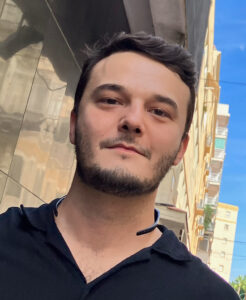 Tolga Aydın is an Istanbul-based screenwriter and author. He wrote the Disney+ series Another Love and the feature films Mühr-ü Musallat: Perihan and The Door. His short fiction has appeared in Turkish and German anthologies. His collection Dünyalılar gathers stories about worlds that don’t quite exist yet.