
by Thomas Ziegler
Translated by Gregory Tracy
THE DAY BEGINS
To dig himself out of the Sand …
In the distance near the horizon, on the scarred peaks, crowned pearly-white even though smoke pours out and cinders invade the plain, out there where the blue-green and grayish-yellow sky and arid ground meet, the sun hangs like a scabby eye a finger’s breadth over the glowing volcano. It is already hot, brutal and dry, totally waterless, and the hoar-frost of the night consists of frozen gas that has long since become vaporized and invisible .
He moves and stretches in the warmth, letting the last grains of sand rain from his silvery skin.
A wind comes up, a whistling breeze, full of dust and gentle coolness. A smell hangs in the wind, the fine scent of a handful of molecules too small to be caught by the hand. Prickly like nickel. Sweet as uranium. Bittersweet platinum, and raw iron. The breeze blows from the horizon, from the depths and cracks in the gorges, where the cold air of the night has laid hidden to climb up now in the clear glare of the morning, under the pounding sun, to flee in all directions.
He lifts his leg. It creeks softly, still stiff from the inactivity of the darkness, from whose black nothingness only his bath in the sand is protection. There it is still fragrant. Warm sunlight envelops him, seeping into every fold of his silver skin which is scaly, like that of a fish, and drinks in the rays in great thirsty gulps, shadowy and parched at first, until finally it begins to shine, and takes up the photosynthetic work of the day.
He glances around, eyeless, but not blind, sees sand and sun, up and down melt together on the scarred peak.
Time for the first breath. Sufficient warmth in the crevices of the skin, the light already swallowed and digested, osmotic pressure in, the cavities of the body, he tenses the drooping sacks and opens wide the slits that part zipper-like and whistling, pump in the air, the traces of oxygen.
He is almost surprised by the ignition.
His legs draw in the sand, burrowing broad trenches, the impatience is a trembling in his entire nervous system. Heat begins to radiate from inside him. Stiffened lubricant becomes soft as jelly. Jets of steam drive pistons. Pressure everywhere. A vent hisses. Chrome-white flakes are expelled to mix with the dusty blanket of the desert. All this as the sun rises. As the day begins. He moves. Two steps forward. The ground rumbles hollowly. Even the sand can hardly swallow the vibrations caused by his massive body. He leaves behind a track. His powerful legs stamp their signatures in the waste until the wind picks up, covering them with dust. Another step. A sideward movement. He describes a large circle, full of restrained power, a circle like that of every other day. The circle is completed as he reaches the pit where he has spent the night, not stopping, now increasing speed. Grains of sand spray to the side. Some of them sparkle in the light, and some of them smell good and arouse his hunger.
Powerfully he shears off from the curvature of the circle, nimbly now, though massive and heavy, letting his legs fly, he falls into a steady trot and glides over the dunes that stretch around him in all directions, flat and swirling with dust, only giving way in the north to plant life and black basalt. Where the scarred peaks adorn the horizon. Again, he increases velocity. Wind howls around him, pitting itself against him, his worst enemy, his only opposition in this world lit by the rays of the scabby sun.
Though possessing no ears, he senses in every cell the hammering of the pistons, the zealously working pumps, the gurgling lubricants and the hissing of the hydraulic steam. Even the smacking sound of opening vents. His skin is now mirror smooth, slippery, silvery, offering no resistance to the wind that tries unsuccessfully to slide beneath his underbelly, centimeters above the sand. The wind whistles angrily over the smoothness of his skin, around the curvature of his body, under which the legs lift and thrust, none too fast, none unsure, despite their ponderous strength, quick as the wings of a humming-bird.
The sun revives him.
He picks up a scent wafted over from the scarred peaks. Even the ground awakens. Deep in the earth the bubbling lava is pushed back and forth, driven by gasses, hemmed in by solid rock, and streams towards the horizon. He breathes in the sun to drive off the weakness brought on by hunger. He runs faster and faster toward the scarred peaks where flakes of ash paint the pearl-white covering of the summit and slopes.
He is now a missile enveloped by the wind, perceptible only as a speeding shadow. He runs in a droning bolt across the desert. He breathes and filters oxygen from the air. Running. Living.
The day begins.
THE CHAFF, SPREAD IN THE NOTHINGNESS
“And all that after a twenty year flight. In the ice-heart of course, so as not to turn old and gray.“ The space centurion bored his big toe into his comrade’s behind. “And the planet was white as an egg. From a distance. When you were standing on her she was filthy. Snowy, but filthy. Flakes of soot from the blast furnace of the Holy-Threefold-Church. Even the clerics forged swords and produced ground-to-air-missiles, but they wouldn’t take off their black frocks, not even in the heat of the forge.“ The space centurion caressed his comrade’s scrotum with his left foot. “We had an easy time of it with them, since their pope was shot into the eternal orbit by the first landing troops. A quick slaughter in the apartments of the New Vatican, a few bombs that bloomed like ice crystals, and a few red patches in the dirty snow. That was ‘65 on Montblanc.” The space centurion nodded and gave his comrade a kiss.
And that seventy years ago, thought Tlile.
She walked past the cabin, using as usual the dead metal of the Zero-Jane that wound its way through the broad corridor and disappeared into the vaporous gray twilight somewhere in front of her. The ceiling light was greenish, like the needlegrass on Myrion Cri, like Mater, the sun that shone down on her at birth.
“You weren’t there, you can’t imagine how it was for us. Even film with perfect sensitivity can’t reproduce what the voids do to a man.“
A new cabin. A space centurion talking to the ego-portrait of a woman. The woman was blond and blue eyed, and her eye lashes fluttered as she peered attentively from her frame down at the centurion, who was powdering his nose, and slowly sorting the holographic photos he had spread in front of himself on the folding table.
“I mean, it’s a totally new experience. It’s like the first time you sleep with a man or a woman. You sit on the electronic barge covered with armor, inside it’s continually clicking and whistling and grinding, and when you cross the border, all of a sudden the stars go out. All the stars. It gets dark. It gets so dark you almost lose yourself.
You know that someplace nearby there’s a black hole, you’re in the void, and not far away the enemy lurks in the absolute darkness. When you squat there on this barge, and you’ve even turned off the photon-burner, so as not to be detected too soon, there’s nothing else you can do but take your magnetic lance in your hand and feel your way through your assigned area of space. Always in hopes of finding one of the enemy and hurling him into the gravity pit. Always in fear of getting hit yourself, and drifting helplessly away, right into the heart of the black hole. That’s the way it was in ‘23, my dear, and I never saw a single one of the enemy.“ The space centurion smiled up at the ego-portrait.
A hundred and twelve years ago, thought Tlile as she passed the cabin, and maybe this woman is dead by now, if she hasn’t accepted the lot of a space centurion’s widow and gone to bed in the icy rooms of the cryogenic hotel on Myrion Cri. She moved farther along the Zero-Jane past the cabins of the space centurions who played and made love and told stories of the Great Wars, whose meaning having become obscure in the passing of the millenniums, now only the centurions and politruks could make out.
Tlile tapped the gold headband she wore like an unpretentious diadem. She could now receive the stream of data on the silent wavelength from the comp-agents that untiringly collected information and, with their multisensors, spied out an entire planet.
While we’re down here, thought Tlile, inside granite that has taken millions of years to grow, and beside which even the people of Old Earth are like infants.
She went further, her mind on the wind speeds and temperature variations in the Bleachedbone Mountains, where the day had already dawned. Bright and hot, hot enough to cook eggs, and turn water to steam.
Shortly before she came to the great airlock that separated the octopus arms of the underground station from the fat body of central control, she ran into Rino Zle, the space centurion’s boss who seemed to hurry through the corridors at all hours, searching perhaps for his life that had escaped him in the light years. Zle was old, three thousand years old, even if his hair showed only a slight touch of gray, and his heart and limbs were still strong. Most of these years were spent in the ice hearts of interstellar ships whose sails billowed in the photon wind, and could even reach Old Earth, if one had ten thousand years time.
“The best days“, Zle called after her as she hurried past him, “were on Lyra. In the forest. There are no forests on Myrion Cri – at least not then. The enemy had hidden himself in the woods thinking himself safe, but we were prepared for that. We sent up a spray ship and dropped a million tons of herbicide 121 down on ‘em. The leaves shriveled up. The branches rotted. The trunks turned soft and made a cellulose mush. Most of the enemy drowned in the green muck, and the rest ran out of the Woods right into our arms. That was eleven hundred years ago, and I still remember.”
Yes, Tlile said to herself, pressing her right palm against the airlock bulkhead, that’s the way it is with space centurions. They’re ghosts from the past, even after the first sleep in the ice heart, they disappear from the world with nothing to hold on to, separated from their lives by decades and centuries. All they have left are their medals and memories.
She thought about Myrion Cri.
Thirty years back.
I’ve disappeared too. Tlile shivered. I lost thirty years on the flight to Simbatrill, and all my friends have grown old and become strangers. There’s no friendship for those who take to the stars. Just short acquaintances because everyone knows it will all be over in the not to distant future.
“A happy workday“, said the airlock door. “The war goes on.“
“The war goes on“, agreed Tlile. The bulkhead opened itself just for her, and as she glanced behind her she saw Zle leaning against the wall staring back at her. His eyes made her uneasy and she turned quickly, stepped into the airlock, and waited impatiently until the second door opened revealing the maze of central control.
It was an arched vault with steel ribs and supporting pillars of special plastic and invisible magnetic fields. Its dimensions were made unclear by the dark, cloudy curtains that separated the vault into numberless individual segments. Tlile was reminded of a shadow land, a place where strange castles float in the air, apparently weightless, separated by the flooding polarized light, supported by girders whose diode covering had the effect of so many eyes.
Tlile tapped her headband and a greenish disc separated itself from the gloom and slid silently toward her. She dropped gratefully onto the anatomically formed disc and was carried through the many levels, recognizing the silhouetted forms of technicians and scholars.
The disc found its way alone, as always at the beginning of a shift, drove through the insubstantial web of the fog curtain and was plunged into light. It was clinically bright in the research center. The walls were white, decorated with control panels, crowded with monitors and displays. Computers arose everywhere like technical tumors, controlling the movements of comp-agents, recording and sorting the Information received.
Tlile jumped off the disc and saw herself for a moment in the mirrored surface of the holo-tank.
Tlile was fragile and small, with soft hands and a narrow face, as narrow as her almond shaped eyes. Her hair and lashes had a reddish gleam, almost the same color as her nipples, that were protected from drafts and cold by a see-through blouse. Her sprayed-on pants were black as tar, but became transparent between her legs. Her skin was somewhat pale.
“The war goes on, Tlile“, she was greeted by the scholar Ornia, and felt Ornia’s moist lips momentarily against hers.
“The war goes on“, returned Tlile and gave the younger woman a quick smile. “You’re looking good, Ornia.“
“I look terrible“, said Ornia, flattered.
Berd – the male scholar with blue and gold tattooed testicles, scurried excitedly among the Instruments as usual – gave Tlile a nod and mumbled something indecipherable.
“There”, said Ornia and indicated one of the monitors. “Punctual as a quasar’s heartbeat. You remember we thought – we had lost him, but the comp-agents were able to track him down during the night. Will you take over?“
“I don’t think I can“, returned Tlile politely.
She stepped closer.
Desert. Blazing heat. White sand. A sky, green and blue. Dust, wafting over the dunes in long fibrous swaths. And the Marathon.
The Marathon …
Tlile recognized him immediately, he had grown so familiar during the many shifts she had spent in central research.
The Marathon was a giant. He breathed strength. Natural power. He was silver, and the sun covered him in a flaming aura. If it weren’t for the legs, those stamping, untiring pillars that drove this monstrous body across the desert …
A picture came to Tlile’s mind. The express trains on Myrion Cri, the way they crossed the swamps in the north and. the endless needlegrass-land in the West on the electromagnetic track. Streamlined. Narrowing in front, the pose a single millimeter above the ground, then growing wider in back, like a rocket.
The Marathon had much in common with those express trains.
But he was an animal.
If one could call the things that existed on Simbatrill animals.
The computer blended in figures continuously onto the Monitor.
Almost five hundred kilometers an hour, thought Tlile. That fast. And he’s generating about a megawatt. He must still be starved from the night. He’s used up all his reserves to fight the cold.
The cold … Tlile’s lips parted anal she leaned back as she felt Ornia’s hand on her behind. It was twenty degrees Celsius at night on Simbatrill. Like a sunny spring day on Myrion Cri. But for the Marathon this temperature was deadly if he didn’t bury himself in the sand. Out there in the open he had to use all the energy he had generated and stored just to keep from freezing. Ornia’s hand slid further between her thighs, between the hairless lips of her vagina, and with a soft moan she continued to follow the Marathon’s course, although she knew his destination, it was the same every day. Her crotch was now moist, unlike the volcanic aridity of the Bleachedbone Mountains – where the Marathon’ s ancestors had laid themselves to rest, and where their ponderous skeletons still reached towards the sun like sculptures of iron, titanium, nickel, copper and gold. Tlile leaned against Ornia’s hand, against the nimble movements of her middle finger that massaged the softness between her legs, as the Marathon’s legs moved untiringly to carry his silver body across the desert.
“Three hundred years ago on Tka Otker“, the scholar Berd said over Tlile’s quiet sigh, “I lay on the beach of a red ocean. The ocean was red from the seaweed that floated a few centimeters below the surface. You could walk across the sea without sinking any further than your knees. The seaweed was full of iron, that’s why the dirty, bloody coloring. Our assignment was to find a fast, cheap way to harvest the seaweed and filter out the iron, since the enemy had gotten closer through a retreat at the front. A biochemist whose name escapes me developed a strain of virus that separated the iron from the seaweed and saw to it that the metal sank to the bottom in clumps where big, complicated machines could scoop it up. I stayed to watch the construction of the first planet-to-planet rockets, then I took a transport into orbit and slipped into the Starsailer’s ice heart to whisked off to Simbatrill. I still remember that Tka Otker no longer looked red from the air, but gray.”
Tlile felt the heat growing in her loins and gave herself fully to Ornia’s untiring hand. On the monitor the Marathon was still held in the crosshairs of the comp-agent, whose lenses were sturdy enough not to be blinded by the strong ultraviolet radiation. The Marathon had reached the foothills of the volcanic Bleachedbone Mountains, and fell into a restless, expectant trot.
ASH FLAKES
… until he can’t stand it anymore and screams loud and angrily up at the stone walls, the spiny crest, and the giant craters of the volcanoes that grow in the mountain range like tumors.
He has won strength from the run, the strength of life that leaves him at night only to cause his rebirth when the day comes. A continuous back and forth like morning and evening twilight. Always bringing him in the end back to this place, where he reluctantly slows his pace and doses sulkily, while under his feet sand is crushed and violet lichen-like forms steal swiftly away. Restlessness and as eternal as hunger.
Hunger… He screams again, louder this time, ignoring the faint echo that is no echo, but the call of another who runs back and forth at the foot of the mountains, awaiting the fall of the ash flakes.
He whips around, his skin flashing in the harsh glare, with pounding pistons and hissing vents, filled with longing and lust for speed and the groaning earth, shaken by the drumming of his untiring legs.
He is fast and heavy, hungry for life, a life that can only be found in the distances of the flat wasteland, in the whistling of the wind on his smooth skin, and in the satisfied gurgling of his enzyme-filled stomach. Silvery, flashing, he trots slowly, not even a hundred kilometers per hour across the fine gravel that has replaced the sand here, offering the violet lichen an infinity of hiding places. From the glowing heat of midday, and the heavy steps of the Marathon.
A rumbling deep in the earth and he picks up speed, crushing gravel to dust and flattening the lichen that begin to seek shelter from the threatening murmuring in the depths. The rumbling is answered by the sky, by the black rounded peaks, the volcanic craters emitting steam and gray smoke. Further down, half-way between the crater opening and the base of the mountain, there where it glistens pearl-white, the earth seems to swell. The whole mountain begins to move. The first ash flakes appear. They shoot high into the air only to be caught and swirled by the wind, finally finding their way to the upper air currents and drifting off in the direction of the desert.
Empty, hungry, he jogs away, silently counting the foamy white balls that seem tiny, from this distance as they separate themselves from the volcanic slag and begin to climb. At first they are few, a thousand at the outside, but their number increases continuously. With every rumble from the volcano a new piece of blue-green sky turns phosphorescent white. At first chain-like, and then like a strange hat, the eerie bubbles surround the volcano’s crater.
So that it spits fire.
Smoke and hot steam, lava, thin like soup in which glowing fragments float. The white dome is cracked by the violence of the upward pressure that has gathered deep in the earth, forcing its way to freedom in the form of pillars of fire, gasses, and molten metal and stone.
Sparks are reflected in his silver skin. He speeds away, diving into the wind and the storm that has come up, spraying him with ash. He runs back into the desert, hungry, ever mindful of the fiery mountain and the volcano’s pearl-white cap, now grown dirty from soot and heat. The tiny white spheres are boiled and steamed by the thousands, torn by the thousands by the storm. There are so many that the mass of their bodies begin to dampen the volcano’s violence, until it is completely subdued, and the flying bubbles begin to feed.
Sour titanium. Gold, so soft, so cool. The sweet smell of nickel.
His excitement grows with every passing second.
The sweetness of uranium surrounds him like a veil.
FROM ONE OF THESE STARS
They floated out in space. They circled the sun like dull moths with folded photon wings and huge glittering nets of solar collectors that soaked up the light of the scabby sun. From up close its face was glowing and large-pored, with protrusions hanging like thick whiskers from its cheeks.
“The cold of two hundred years“, said the politruk and rubbed his hands in the warm blast of air from the dryer, “doesn’t leave the human body so quickly. One is afraid of breaking in a million pieces from tripping or moving too quickly.” He put himself completely under the dryer and let the drops of water be blown off his bare skin. Here in the relatively cool antechamber, his scrotum and penis were shriveled and shrunken after the warm shower, and Tlile was almost astonished after the long months she had spent with Ornia, without men.
How ugly he is, thought Tlile. A new ghost on Simbatrill. And to think how many are still up there orbiting around the sun …
“The evacuation went quickly and without complication“, continued the politruk, anal reached for the spray can to dress himself. “The population was well behaved, and the space centurions dutifully kept order while we got the important people into orbit and into the six waiting sailers. The multi-functional comp-agents cruised at the edge of the system and blew the oncoming planet-to-planet rockets into a thousand different colors that you could see even through the thick atmosphere on Lourd.“ The politruk sprayed his upper body green, his arms blue, and slipped into a pair of colorless synthetic shorts, adhering to a fashion which no one had remembered for at least three hundred years. “The attacking rockets had been on the way for four thousand years. We know that they came from enemy planet Number 96. Slow, old-fashioned missiles whose chips and squids reacted a lot slower than the electronics in our armed comp-agents. The battle had been raging for two weeks, quite a ways from Lourd, in the orbit of the outer planets, when we realized that our highly advanced four-thousand-years-further-developed technology was helpless against the raw numbers of the attacking missiles. It seems to me the Old Earth doesn’t think in terms of centuries, but millennia. They know the complications of an attack that takes four thousand years to reach its destination. I don’t know the exact number of rockets aimed at Lourd, but it was enough to eventually destroy our comp-agents. That’s the only reason we retreated. We had just located a gap in the swarm of rockets, headed away on the photon wings, and were about to slip into the ice-home when a missile broke through the defenses and obliterated Lourd.“ The politruk nodded slowly. “That was two hundred and eighty years ago, but to me it seems like yesterday.“
Yesterday?, thought Tlile. There is no more yesterday. No today, no tomorrow. There is no more time for anyone who’ s lain even once in ice sleep and flown from star to star, for two decades or two millennia, without aging a single day.
The politruks up there in the sailers, the notables from Lourd, the space centurion bosses who made the flight, all of them had fallen out of their world to become ghosts.
“The war goes on,” declared the politruk.
“The war goes on,” said Tlile. Inside she asked herself: What kind of a war is this where a missile takes a thousand years or more to flatten the opponent? What kind of a war is this where the people on Myrion Cri have built and launched missiles for three or four centuries, aiming for stars ten thousand years away that none of us have ever seen? And when they hit, they destroy an entire planet.
We want to kill, thought Tlile, even if our victims aren’t even born yet. And out there in space cold steel and dormant fusion, are closing in, made by people that have long turned to dust.
“The loss of Lourd“, mumbled the politruk, and led Tlile into the living-room of his suite in the twelfth tentacle of the underground station, “has made a sensitive gap in our defense system. We had covered enemy stars 33 to 38 from Lourd, and had a clear path all the way to Old Earth, undisturbed by gravity holes, black clouds and radio storms. We launched maybe twenty thousand rockets before the annihilation of Lourd, and naturally we hope that a few of them will eventually wreak revenge on the enemy planets.
“What if those planets are empty?“, remarked Tlile, and glanced quickly at the two guards waiting at the door, without whom the politruk did not dare to leave his suite. “What if the enemy found out and evacuated them? What if these colonies have been given up? What then? No one can alter the course of the rockets once they have been launched, there’s no ship that can reach them.“
The politruk yawned. “You’re quite intelligent“, he remarked.
Tlile closed her eyes. “I’m quite stupid“, she replied modestly.
“Modern warfare“, said the politruk, and yawned again, “has had that problem solved for a long time. The enemy too. The solution is costly, but absolute. We know the enemy’s expansion rate to a tolerance of four to five hundred years. Our rockets are only secondarily aimed at the enemy colonies. In reality, we fire at the stars. All stars within the enemy’s sphere of influence. Every planet hit, whether populated or unpopulated, is destroyed by the rocket’s warhead. In this way, we don’t miss any of the enemy’s old colonies, and we prevent his having the opportunity to settle new worlds.”
Tlile wrinkled her brow. She felt hot, and the guards who directed their stares at her naked lap irritated her. “But how do you know if our rockets have reached their destinations? Maybe the enemy has destroyed them, and while we sit here thinking ourselves safe, a new swarm of enemy planet-to-planet rockets is taking off from that very planet.“
“It’s a matter of repetition“, explained the politruk bored. “We don’t fire on each planet just once. This method has existed for two thousand years. We repeat the attack at certain intervals .”
“I don’t understand“, confessed Tlile.
“I admire your understanding“, said the politruk politely.
“What if that world was actually destroyed? Four hundred years ago? Isn’t it a waste to attack them with a new swarm of rockets when they are no longer a threat?”
The politruk smiled for the first time. “It would be a waste if this planet has been destroyed. But who can be sure? Would you want to risk your life on it?“
I don’t know, thought Tlile. I don’t know. This war… When did it start? Why? When will it end? If it ends… And even Old Earth could already be rubble without our knowing it, while we’re still busy building rocket after rocket.
“The war goes on,” Said the politruk.
“The war goes on,” nodded Tlile, and left the room.
DEEP IN SPACE, ONLY TEN THOUSAND YEARS
Like a vortex of gray and rock, here misty-white with gasses condensed in cold and darkness, there shimmering with gold, jagged with debris, a veil, four dimensions wide haloed in the glow of the Stars, lit from the inside by the glare of the one sun, the tangled mass revolves in silent pirouettes through time and space, racked by queer twisting and trembling when the photon wind blows. Violently.
HUNTING FEVER. WHEN GRAINS OF DUST DANCE
… so that nothing gets in his way he avoids the wandering dunes that range through the desert like narrow aisles and cut his speed in half, follows the course of the pearl-white spheres with sharp, attentive senses. Fully fed, pumped full of volcanic gasses, in the grip of the increasing storm they climb higher, until they reach the air currents that whistle across the mountains and die out deep in the desert in the warmth of the sun.
The spheres float away swiftly, twirling, rising and falling, at this moment still faster than the silver giant. He seems to stretch, to grow flatter, diving beneath the wind that blows against him. His legs touch the ground for an instant to thrust his massive body forward, lift, touch again, while inside him the pistons hammer, filling every cell with their vibration.
His speed increases.
Even the air pits itself against him, but his muscles are steel springs. He notices that the white spheres are now over-head, still too high to reach for, but he is impatient, and opening the cleft in his back, lets the rolled-up tongue flip upward, the jointless arm, sticky, like half-dried glue. His attempt fails, arid the tongue with its metal Supports falls back, rolls up and lurks on its catapult.
He keeps running. Grains of sand spray up on all sides surrounding him like a cape, a curtain of sand that grows steadily larger. He is now painfully aware of the emptiness inside him, the chamber of cooled air in which the steel cigar-shaped organ lies waiting to be fed, to be filled.
It is still early, but the night was cold, and has dwindled his reserves. He knows he must hurry if he is not to lose speed, finally coming to a stop, lamed, living from the photosynthetic energy of his silver skin, finally to die, and roast in the sand in the march of the seasons. Disgrace threatens if he is unable to reach the scarry peaks before his last step and lay himself down there. With his ancestors, whose silver skin spreads itself like a blanket over their bones.
It has grown hot, hot as an oven, and the lubricating fluids in his powerful body have grown thin, needing to be thickened by enzymes. In the heat the cold air currents that carry the spheres lose strength. The spheres sink.
They float to the ground pearl-white, out of the grayish-blue and the glare of the scabby sun.
Tender groups of molecules plunge groundward. He catches them. Bittersweet platinum. Sweet uranium. Nickel and copper and silver and gold.
With a volition of its own, his tongue springs out again, wrapping itself around one of the bubbles. The silicon covering crunches apart. Light gasses waft skywards. He tastes uranium. He tastes gold. He tastes ash and sulfur, copper and silver. He pulls his tongue in swiftly, sending the traces of metal to his stomach where, smacking and gurgling, the acids and enzymes begin to work. The tongue speeds upward again, snaring another sphere, two, three, a dozen. The half-organic stickiness of the long, supple tongue bursts the spheres immediately.
He runs.
Every bite strengthens him. His insides are in an uproar as his organic-metallic arteries send the digested traces of metal to his vital organs. Another sphere. The uranium’s sweetness even makes him stagger slightly.
His speed increases.
Like a frog snapping at flies, the Marathon snaps at the pearl-white spheres.
Until he is full.
And enough uranium has filled the cigar-shaped organ, and an enzyme has done its work. Ignition. Chain reaction. Atomic processes. The steam in the chamber is heated, expands, and drives the pistons with renewed energy. The legs move in frantic rhythm.
Running.
Slits in the silver skin direct air for cooling into the overheated chamber, whose skin is thick, and hard as steel. The pistons receive more pressure.
The Marathon runs. Sand sprays to the side.
He runs, and still has time until night.
OVER THE DESERT
“As barren as Drog where I stopped on my first flight“, said the space centurion, and peered down through the jet’s transparent floor at the dunes that seemed to dance in the warm air. “I was young then, three thousand years ago, and in those days we still attacked the enemy with star sailers, and landed troops on the enemy colonies. I had spent four hundred and fifty years in the ice-home, still thinking about Myrion Cri, then I woke up and saw this desert world in front of me. The enemy was poorly armed but tough, and ready to fight, and they knew the ins and outs of the desert. The abrasive sandstorms and the plains of fine dust, in which you could sink and be helplessly lost. We attacked them with three thousand men and destroyed their settlements. Those who didn’t get away were taken captive. They had to build armed camps in the desert that were then guarded by our comp-agents to keep them from getting reinforcements. I don’t know how many days full of heat and dryness went by on Drog until the enemy’s guerrillas had rubbed out the majority of our troops. More drastic measures were needed if the rest of us wanted to save our lives. Eve started up with the transports, apparently defeated, but the enemy forgot that we were space centurions. We ignited a cobalt bomb at the north pole and watched while the wind carried the fall-out over the whole planet. That’s the way it was on Drog three thousand years ago. I don’t shed any tears over that desert planet!“
With a lazy drone the jet speeded toward the thorny outline of the Bleachedbone Mountains. Tlile rested her weight on her elbows, her rear in the air. The politruk kneeled behind her and with slow thrusts, explored the darkness between her legs. The raw skin of his testicles scratched her buttocks, and the movement of his member aroused only fleeting stimulation in her. She thought about Ornia. The lips of her vagina became moister and warmer. The politruk moaned and thrust harder. Suddenly his excited movements reminded her of the chipmunks on Myrion Cri that swarmed over the needle-grass plains twice a year and copulated assiduously, a favored spectacle for the children.
“After the fall of Lourd“, explained the politruk, and slowed his movements, “we had first planned to sail to Kyrion Cri, but the space centurion bass remembered Simbatrill and this station, which he helped build five hundred years ago. He knew about the Marathons and the research, and his reasoning sounded intelligent and useful.“ He groaned again, louder this time, and Tlile felt the heat of his seed in her. ”That’s why we’re here“, he continued, separating himself from her and shuffling into the jet’s refreshment cell. “And I’m disappointed to find the station so undermanned.“
“’I’m sorry“, mumbled Tlile, and also rose to clean herself.
“It’s all my, fault“, returned the politruk genially.
“It’s the war’s fault“, said Tlile, and reached for a towel to blot the wetness on the inside of her thighs. “Just after construction, news of the destruction of Tjuna reached Simbatrill. Half the garrison and most of the scientists were transferred to Linnister, that was to replace Tjuna as rocket launch center. Research stopped, and eventually the rest of the garrison was also transferred. We landed four months ago after a thirty year flight.“
“Terrible state of affairs“, nodded the politruk.
“You’re optimistic“, said Tlile politely.
„On board the six sailers in orbit around the sun“, reported the politruk and pulled his shorts back on, „are strategically important industries. Computer-controlled rocket factories anal enough electronic hard- and software to equip ten thousand missiles.”
To continue the war, thought Tlile. Against planets thousands of light years away. Against an enemy that no one of my generation has ever seen; only the space centurions, the old ones, who in their thousand year flights in the ice sleep have penetrated deep into the enemy’s star provinces.
“Tell me about the Marathons“, said the politruk.
“I’m sure it will bore you“, said Tlile courteously.
“The mountains“, interrupted the voice of the space centurion who observed the jet’s controls and kept up communication with the comp-agents that swarmed like gnats around the Jet. “We’re almost there, and if those peaks were gold this could be Algneta. The mountains there were made of pure gold, and there were these ugly skeleton men there, the natives, as scrawny as scarecrows, and with faces that reminded one of some burned noodle dish. Those mountains were supposed to be sacred, but we needed the gold for the plating on the planet-to-planet rockets we were building at the planet’s equator. It came to a fight, and we had to dirty those gold mountains.”
The plundering of the stars, said Tlile to herself as she collected her thoughts. The ground gets plowed up to a depth of five thousand meters. Mountains are carried away, and whole oceans evaporated. And the treasures we dig up are sent on the long trip to the enemy suns, with warheads, and antimatter, and computer programming. When will the first enemy rockets appear over Simbatrill? Or over Myrion Cri? But maybe the comp-agents are already orbiting Mater in their restless search for the missiles that roll in in continuous waves from interstellar space. Maybe Myrion Cri is already broken and burned.
“The war goes on“, said the space centurion, who even during love-making had not moved from the politruk’s side.
“The war goes on“, affirmed Tlile. The Bleachedbone Mountains rose now in front of the jet, flickering here and there with tongues of fire from the craters of the volcanoes. Under them lay the slowly rising gravel hills between desert and mountains. The hills shimmered violet. “Due to the short amount of time our research is not very far advanced, and we still don’t fully understand the planet’s ecological system. We have concentrated our efforts on the Marathons and their life cycle. Those lichen down there, those violet growths… They store the steam that seeps from the volcanoes and snows to the ground at night with a part of the atmospheric gasses. They also use the carbon dioxide and a few other minerals they extract from the volcanic soot. After they develop, they climb up the mountain and undergo a metamorphosis.“ Tlile pointed at the pearl-white spheres that clung to the mountainside. The shell of the metamorphosed lichen consists of silicon with a melting point of 1,450 degrees celsius. Inside the spheres are, besides steam and carbon dioxide, also several gasses that are lighter than the atmosphere. So they are able, when their time comes, to rise and float over the volcanic craters. Of course many are killed during each eruption, but even more survive anal score the metal that pours from the craters with the lava. Uranium, platinum, copper, iron, nickel, titanium, gold, silver… On a good day each sphere stores one or two pounds of metal and is then carried by the wind toward the desert.“
“Where the Marathons are waiting“, nodded the politruk.
“You have a talent for comprehension“, said Tlile.
“A fluke“, said the politruk politely.
“Where the Marathons are waiting“, affirmed Tlile. “The Marathons feed on the spheres. First of all on the metal, since their bodies consist mainly of organic-metallic combinations. Machine-like. Then on the steam and carbon dioxide which they transform chemically into fuel for the organic combustion motor that keeps them alive in the morning until feeding. And especially from uranium. In the rounded rear section of the body is a natural atomic reactor that is cooled by the air during running, and produces the energy to heat the hydraulic steam that drives the legs. This is why the Marathons are slightly radioactive.
The silicon shell of the spheres contains seeds that settle on the Marathons skin and are carried back to the mountains daily, where they fall off and sprout new lichen.
A continuous cycle. After eating, the Marathons have to keep moving until nightfall to use up the energy they produce. In the evening, they bury themselves in the sand out of fear of the Gold, and to take in the steam that has frozen and falls to the ground as snow. Movement – that’s the Marathon’s life. If they stand still, the reactor inside them is no longer sufficiently cooled, and they die.“
“Life“, repeated the politruk, keeping his attention fixed on the monitor screen, on the mountains and volcanoes, the lichen and pearl-white spheres. And on the Marathons racing across the desert in the distance, faster and faster, fully fed and full of strength. “The Marathons remind me more of machines.”
“A few things“, continued Tlile undisturbed, “are still puzzling. Such as the fact that the Marathons skin can photosynthetically change sunlight to energy. We don’t know how this happens or what purpose it serves. And the reproduction. Monosexual, heterosexual? No one can say for sure. And …“
“You said that each sphere can carry a pound of metal?“
“I admire your memory capacity“, nodded Tlile.
“I have a terrible memory.“ The politruk scratched his head thoughtfully. “Day after day?”
“Day after day.“
“And how many spheres drift into the desert every day?“
“Maybe five hundred thousand”, said Tlile.
“That means two hundred and fifty tons of metal. Uranium, platinum…“ The politruk continued to scratch his head. “Raw material for a lot of rockets. A lot of rockets.“
“But you destroy the Marathons means of sustenance“, Tlile reminded.
“It’s war“, said the politruk. “The war goes on. Until victory.“
“The war goes on“, agreed the space centurions.
But what, Tlile asked herself, do the Marathons have to do with our war?
MARATHON
… and so he runs, faster than the wind, warm inside, power in all his limbs; speeds from dune to dune with legs drumming, bent low to the ground, silvery, sucking in the cool headwind in deep breaths. Sand crackles against his skin. He doesn’t feel it. Should sand find its way into a vent or into the filter of his breathing slit he spits it out noisily, mechanically, hardly noticing. Should the sand graze his skin too violently, grinding it away, thousands of molecules climb from deep inside his body, diffuse through the artery walls und the thick lower layers of skin to repair the wound. When springs break und pistons fail they are quickly repaired by special strains of virus, the Marathons tiny repair crew that groan under the weight of the collected metal.
He doesn’t hear them.
He must keep running, six hundred kilometers per hour now, in a giant arch, pulling a cyclone of dust behind him. He runs on, satisfied, thoughtful, conscious of the spheres that ended his hunger, and still drift and fall around him. There are only a few left. Hitting the ground, they send a swirl of sand into the air. When they lie in his path he tramples over them, crushing them to tiny fragments and mixing them with sand.
Eyelessly watching he runs, silver under the sun that has now reached its zenith, at home in the desert that erases his tricks and flattens the dunes with the wind, making way for the Marathon.
The spheres are even fewer now, heavy with the weight of the metal they carry, leaking the gas that had held them aloft, they tumble groundward.
The Marathon yells. For himself alone, since he alone hears it, and he runs on, following the curve that leads him deep into the desert where the scarry peaks disappear from the horizon, and the dunes stretch out in all directions.
Two spheres are still held aloft by the wind and accompany him on his run.
Until the evening comes.
THE CHIRPING OF STEEL CRICKETS
The sand was pushed aside, the naked rock came to light, and the walls defended against the shifting sand. Flickering insects hopped from place to place. Here and there beetles crawled through the wasteland on some mysterious errand, swallowed up the desert, and emitted a glass-like fluid that slowly hardened, and was then cut into walls. Humming noisily, their winged cousins dropped from the sky. Crates, drums, containers, and pre-fab building pieces poured forth from their bellies. Ants swarmed everywhere, small compared to the rest of the insect folk, but their numbers ran into the thousands, and halls and houses grew within hours under their iron hands. Deep underneath them the octopus rested in solid granite and awoke from his inactive sleep. The steel spiders spun their webs from pole to pole.
BEFORE THE TWILIGHT
“The volcanic slag has a very low yield.“
”After the spheres – the Marathons? They will have to be counted. A job for the comp-agents. What if we mark them? Shoot a transmitter under the skin?“
“The organization question is up to the computer. The unloading of the star sailers is moving along well. Only the limited number of planet transports is slowing us down. The problem of a water supply for the weapon factories under construction is still unsolved. I suggest drilling. The underground water findings have already been charted.“
“We had more problems on Danae. Swampland, and a planet biochemistry deadly to humans. The boss and a hundred comrades bought it before the first factory was finished. We had to drain the water from half a continent to get to the uranium. The vast oil reserves were of course helpful in the construction of the infrastructure and the base self-support system. In two years the chimneys were smoking and the first planet-to-planet rockets and comp-agents rolled off the production line.“
“You’re too concerned about the Marathons. Our job is over. Leave the rest to the space centurions and politruks. There are always things that don’t make it through the war unharmed. And the Bleachedbone Mountains are the best place for the works. The Marathons here will just have to go someplace else.“
“For the rape?“
“The planned all-out exploitation of the metamorphosed lichen will not only destroy the Marathons’ food supply, it will end the life cycle for both species. No metal-filled silicon spheres, no food for the Marathons. No food for the Marathons, no new spores for the lichen, no more spheres. And then?“
“Two hundred eighty years. Too much time during a war to let them go completely unused. We have to hurry. Maybe there are already enemy missiles on the way to Simbatrill. Our rockets have to be in space before they destroy the planet.“
“Pull your lips over your teeth, otherwise it hurts when I thrust. Simbatrill. I’ll only remember the sand.“
“The latest model stored in our production computer is unfortunately already hundreds of years out of date if you consider the time that has gone by during the trip to and from Lourd … The newest model guided planet-to-planet rocket with anti-matter warhead has highly developed photon burners that can accelerate it to the speed of light in five days. Solar collectors sensitive enough to use even the weak light of the stars supply the electronics during the flight with enough energy for small course changes and battle preparations. Two dozen warheads, also self-steering, high acceleration, protected by certain precautions against premature detection, can be fired off as soon as the target star has been reached. Their explosion is sufficient to wipe out an entire solar system with twenty-four planets of Simbatrill’s size, or at least to pound some large holes in the enemy’s space defense network.“
“How much usable metal does a Marathon contain?“
“Wouldn’t it be possible to use their – uh – organic atomic reactors commercially?“
“I won’t sleep with you anymore. Not even out of politeness. I’ve realized that I don’t like men. Especially men like you.“
“At nightfall the temperature drops to twenty-four degrees, and even further in the next few hours.“
“The sand is much warmer near the volcanic chain. Something to consider. A lot of the Marathons probably spend the dark period there.”
“The space transport’s crash completely destroyed the cargo. A program defect in the auto-pilot. What do we do without the crystals?“
“You’re very attractive.“
“I’m boring.”
“On Yin the colonists refused to finance the construction of rockets. We had to hang three thousand of them by the neck, and still had to fight against sabotage after that. Years later the water tasted like crap and chemicals, and gray fog hung over the big cities. Then we left Yin for good. From then on an armada of comp-agents defended their system, and we sent forty thousand planet-to-planet rockets into space. Who knows, maybe someday Yin will get an answer, in two thousand years.”
“We have to make provisions for continued supplies. If we crack open the silicon shell and get out the metal we could plant the seeds at the foot of the Bleachedbone Mountains ourselves.’”
“And these skeletons? The Marathons? How many are there? Would it be worthwhile to collect them and melt them down?“
“I abhor you.”
“You’re too kind.“
RENDEZVOUS, ON LAND AND IN THE AIR
… for he too notices that the day is drawing to an end. But the soft scent of the spheres lets him run on with an easy elegance, trotting from dune to dune, allowing steam to escape from a vent. His body is still full of energy, there is still pressure in the pistons, but the time is growing near when he will be forced to change course, and hasten back toward the scarred peaks that disappeared from the horizon hours ago. The pearl-white sphere is tossed in the breeze, losing altitude steadily, nearing the sand and the racing silver giant. Restlessness fills the Marathon, knowing how seldom these moments are and how often he has fruitlessly run into the endless desert after the spheres, though satisfied and full of energy. Only one is left, and the moment comes when he must make the decision he has never considered before. In one motion the Marathon throws himself forward, reflecting the glare of the diminishing sunlight, and reaches out with his tongue for the sphere that falls just at that moment, heavy, and empty of gas, threatening to shatter on impact. Brittle from the flight and the heat. He is just able to catch it and, holding it protectively, pulls it down into his body. No hesitation has slowed his pace. Droning and heavy, his legs carve their way through the sand, carrying him at a fantastic pace across the wasteland. The sphere lies safe and unharmed in the cavity for his catapult, wrapped in the paleness of the elastic tongue, revealing only a tiny, patch of pearl-white.
The Marathon howls out loud, a scream like the cry of a bird, and the blowing of a whale upon surfacing from the depths of the ocean. High pressure air floods with quick violence into a chamber, driving a rod into the pearl-white sphere without breaking its shell. Still running, the Marathon pumps virus spores into the sphere, crystalline microscopic messengers that carry complex genetic plans and will penetrate the round, undeveloped control centers.
Thundering across the desert the Marathon squeezes the last drops of the thick, sticky fluid through the hollow passage inside the rod. Then the job is done, and he spins around, causing a short dust storm, and rushes back toward the mountains.
He runs as if freed from a heavy load. Shimmering and fast, he speeds forward, a victorious runner in the last few meters of the long road. His thrusting legs are unrecognizable shadows.
Droning fills the desert.
When the Marathon runs.
THE ONLY ESCAPE, A PLUNGE TO THE DEPTHS
With flaming burners the jet drilled its way through the sky that was now gray, and would soon darken completely.
“Come back“, Said the politruk over the silent frequency in Tlile’s head.
“No, she retorted stubbornly, and switched off the automatic pilot in order to pull the jet’s nose still higher and climb like a space transport in its leap into orbit.
“You are quite honest.“
“I lie frequently.“ Tlile kept her eye on the monitor and saw the small point on the edge of the detector growing larger. Both the station and the construction sight, that was now covered with a flexible dome containing a breathable oxygen atmosphere, were now behind her, and her pursuer was too slow to catch up to her.
“I don’t know what you hope to get out of this, Tlile“, continued the politruk. His yawn was a whispering in her thoughts. “It’s useless. If you don’t turn around, you’ll die out there from lack of oxygen. If you do come back, you’ll be arrested and brought to your court-martial in the ice-home of a star sailer, if I don’t give the order for your punishment before that. You can’t accomplish anything, Tlile, and it’s a shame to lose your manpower. The war goes on.“
“Without me.”
“Your quite courageous.“
“I’m afraid“, said Tlile, “You’ll kill the Marathons.“
“We’ll win the war.“
“A few more years research“, explained Tlile thoughtfully, “and we could find you a method to get the metal from the spheres without endangering the Marathon’s existence.“
“We have to build rockets. Comp-agents to defend the System. We had to wait two hundred eight years. Now we’re not frozen anymore.“ The politruk sounded impatient.
“You’re a ghost“ , said Tlile. “We’re all ghosts . When were you born, politruk? Five hundred years ago? Or four thousand? How many years have you already spent in the ice-home? Myrion Cri is as strange to you now as Old Earth, so what are you fighting for?“
“The war” returned the politruk, “is not a matter for a few years. Ask the space centurions, they know.“
She heard other voices.
”It was twelve hundred years ago, and we were all sleeping in the ice during ten generations that were born and died on Myrion Cri. Pleja was our target, and it was in enemy hands …“
“My longest flight was nine hundred years, and the same for the trip back. But my hair is still black, and there’s not a single line on my face. I don’t even have to think about wrinkles for a long time yet.“
“Ghosts“, whispered Tlile and pulled the jet out of its climb. It wobbled, then shot off high over the desert.
“Come back“, repeated the politruk.
“No“, said Tlile.
“Then you are no longer one of us.”
“Then what am I?“ Tlile concentrated on the controls.
“You are the enemy, Tlile. You’re theirs now. You’ve betrayed us. The war goes on.”
The voices quieted and then disappeared from inside her head. The jet was supersonic, and it wasn’t long before she saw the enlarged form of the Marathon on the screen. The Bleachedbone Mountains were growing closer. The Marathon galloped across the wasteland, graceful, and yet powerful.
Tlile slowed the jet and dropped lower. She watched the silver body of the Marathon who sought out the vicinity of the mountains as always before nightfall. She followed him curiously, realized how small the politruk was compared to him. She wished she could have Ornia sitting here next to her in the jet, missed her friend’s tenderness. She was lonely in these few minutes when her feelings began to clear, and anger and rebelliousness began to fade.
She couldn’t do anything – as the politruk had said. The war went on, on planets, in space, even in the black clouds. The space centurions’ sailers crossed the galaxy untiringly, looking for new planets with enough raw materials to supply the factories and comp-agents. A thousand, or two thousand years later the planets went up in flames when the enemy had succeeded in tracing the rockets’ course, despite complicated deceptive maneuvers, back to their base.
What am I doing here?, Tlile asked herself. Was I going to save the Marathons? From this war that lasts eons, and whose end is nowhere in sight?
She noticed the steel spiders on the mountainside. Their nets were growing, and in a few days would be dense enough to catch the spheres like a swarm of fish and carry them back to the station.
Below, the Marathon left the desert sand and thundered across the gravel and lichen in frantic haste, continued on to the foot of the mountain where the skeletons of his ancestors glittered copper and gold. He ran in a tight circle, digging a ditch with his flat, metallic nose, throwing ash and rock wildly in all directions.
Tlile stopped the jet in mid-air. Astonishment showed on her face. Not a single comp-agent had reported such behavior during the last four months. The Marathon circled faster. He seemed to know that only a short time remained until darkness and cold set in. Something flashed pearl-white. A sphere rolled from an opening in the silver body and came to rest in the middle of the surrounding ditch.
Now the Marathon had stopped, bathed in the grimy red of the sunset. He dropped heavily on top of the sphere, but Tlile was sure that he had not crushed it, but only meant to warm it, as a mother bird it’s egg. He lay there, and there was no doubt that he would in this very night grow stiff and die, at the same time protecting the egg: with the warmth of his escaping life.
With a jerk Tlile tore the jet around, ignoring the creaking and groaning of the metal that was overstressed by this maneuver, and shoved the airspeed regulator to the highest scale reading. The jet ripped through the night like a bolt of lightning.
The Marathon was left behind, enjoying the silence.
It was dark and late when the politruk spoke to her again over the silent wave-length, and the detection instruments indicated her position almost directly above the Station.
“It’s good that you’ve come to your senses, Tlile“, said the politruk.
“I’m a fool“, said Tlile.
She switched off all the instruments except the reactor, which continued to produce energy, and quickly became hot during the plunge through the night. Tlile was sick with fear.
“You’re quite brave“, remarked the politruk.
“Quite“, whispered Tlile.
ON THE MOUNTAIN
… the Marathon lays in the darkness. His silver skin has become dull and is almost invisible in the night. He lays there, still restless in death, drawing busily with his les that will never again carry the iron body through the day. And though the clammy dew gnaws at his insides, and flakes of gas and evaporation have slowly covered him, his dying proceeds slowly, and will not end until morning. Under him, protected from cold and the nightly storm that whistles around the summit, covered by his mighty ancestor, the Marathon ripens, to one day raise himself up from the dust, still small, but ready to grow, and climb over the dunes with his thundering stride.
Originally published as “Marathon” in:
H.J. Alpers (ed.) Der große Ölkrieg, Moewig, 1981
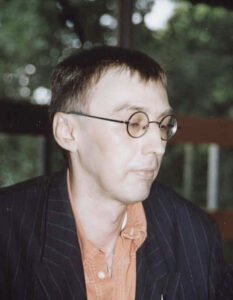 Thomas Ziegler, the pen name of Rainer Zubeil (1956–2004), is generally regarded as one of the greatest talents of German science fiction. With his short stories that began to appear in magazines and anthologies in the late 1970ies, he provided the initial impetus for a new German science fiction that was characterized by topical subjects, local color, near future settings in Germany and socio-political brisance. Also known as head writer of the Perry Rhodan series, translator, critic, editor and crime and TV writer, his untimely passing prevented a comeback in the science fiction scene. His most important works are, apart from his stories, perhaps his cyberpunk novel Alles ist gut (1983) and the nightmarish alternate world novel Die Stimmen der Nacht (1984). Michael K. Iwoleit edited a selection of his best stories for the book series Cutting Edge, an imprint of our host publisher p.machinery.
We have little information about translator Gregory Tracy, except that he was an US student living in Cologne. Author Rainer Zubeil met him in a local bar and hired him as a translator.