
by Thomas Grüter
The hide was crammed full and the four of them could hardly move a limb. At least they could talk, as long as the croakers were still out of sight. The scientific name of that species was more elaborate, of course, but because of the rough sounds they produced, the members of the wildlife safari had nicknamed them croakers.
“Why do we waste our time in this shit hole to observe a species, that is not even native to this desolate spot?” Viifalura grumbled. „The ridiculous price of this ‚luxury tour‛ should have bought us a tiny bit of comfort, if you ask me. Why don‛t we watch the croakers from the shuttle? Or in their cities?”
„Asshole!” thought second class scholar Flosiidij. Videos of the croakers moving about clumsily while uttering rough sounds had made the planet famous. But it was nature reserve and all research expeditions needed a ton of different permits. Flosiidij suspected that Viifalura had only joined to show off to his society circle. In any case, the guy had no scientific ambitions. He had failed the entrance exam of the academy spectacularly rendering him ineligible for a retry. On the other hand, the tour operator had received a generous contribution to the expedition expenditure from Viifalura’s family head.
Heeriidoo, the respected senior first class scholar, felt obliged to put him in his place:„The terrestrial pseudo-intelligent life form of this planet, which you call croakers, tends to attack anything they consider unfamiliar or threatening. Therefore, getting close to their population centers is strictly forbidden, confining us to observing small groups in remote locations.”
Heeriidoo used the classical harmonic language for his rebuke, an intricate polyphonic melody of hums and whistles. Flosiidij doubted that Viifalura understood much of the meaning, let alone of the subtext.
Heeriidoo continued:
“According to my theory, an intelligence capable of interstellar space travel will only occur in aquatic beings, with cephalopods like us enjoying an extraordinary advantages because we lack hard tissues limiting the evolutionary growth of the central nervous system. In terrestrial animals the case is even clearer: the overabundance of bones and muscles will necessarily prevent their nervous systems from reaching a size sufficient for real intelligence. They will only develop a kind of pseudo-intelligence, similar to state-building insects. When they show up in small groups, as they do here, their behavioral repertoire will most probably be reduced to a minimum. It is this very theory we want to prove in this expedition, and this is the only activity covered by the council‛s permission.”
“It’s my theory, and I obtained all those permits,” Flosiidij thought angrily. “And then this ringed tentacle spreader forced his f…ing way in.”
He carefully shielded the thought from the ganglions controlling his chromatophores, because otherwise his anger would have shown as a blue-stained discoloration. In his current position, this was not really advisable. As it turned out, Heeriidoo wasn’t quite done with Viifalura:
“Even from participants owing their place to their family’s patronage I do expect an honorable behavior, even if the narrow gene pool of their ancestry may have a negative impact on their cognitive performance.”
“Ouch, that hit home!” thought Flosiidij. There was an awkward silence after Heeriidoo’s tirade and Vooraial, their guide, hastened to give his formal welcome speech:
“Excellencies! On behalf of Galactic Wildlife Travel, the leading provider of wildlife viewing tours, I feel honored to welcome you to the highlight of our tour to this planet. First of all, I would like to remind you that the hide is surrounded by a high-energy protection field that maintains the necessary aquatic environment in the hide even though we are several standard tentacle measures above sea level. I would strongly recommend you not to touch the field with two tentacle tips at the same time. This would close a high-voltage circuit causing considerable pain and and maybe muscle paralysis.
As required by federal regulations, an emergency circuit will kill the field before any serious damage can be afflicted, but believe me: you don’t want to go through this experience. Therefore, excellencies, please do be careful. Galactic Wildlife Travel shall not be liable for injuries and damages due to careless or negligent behavior.”
“Pointing with two tentacles is bad manners anyway”, muttered Viifalura.
Vooraial said: “Here they come. Unfortunately, the field membrane tends to amplify our voices and they might hear us. Therefore I would ask you to stay absolutely silent.”
#
Bob Mansfield, with full title `The Honorable Robert Charles Mansfield`, never really felt attracted to exploring the biology of penguins, whales or fur seals. Still, on this arctic summer day he hurriedly stumbled along the rocky footpath so as not to fall behind the other wildlife photographers.
After Mansfield had quit his job in the Foreign Office two years ago, he had decided that wildlife photography tours to remote spots were an appropriate occupation for an affluent gentleman. His wife’s adamant refusal to accompany him bolstered his determination. So far, he had adhered to the stoic ideal of apathia, the ability to endure life without any tempestuous emotions while doing his societal duty. Wildlife photography was the first occupation in his life producing results that were as aesthetically pleasing as they were permanent, two qualities he had never experienced in his professional career. And much to his surprise, he had noticed that he was capable of a feeling of passion. Within two year, he had turned into a happy person, a change that he had never dared hope from life.
He had even come to terms with the fact that he shared his hobby with nouveau riche doctors, lawyers, and ex-managers. Without complaining and loaded with his bulky photo case, he toiled up steep paths in the tropical rain to observe mountain gorillas, or like today, climbed down a hill of slippery, moss-covered stones in South Georgia. The weather matched the expectations of a subarctic summer day: 8 degrees Celsius, a stiff breeze and occasional showers.
About 20 male fur seals lay on their bellies along the beach keeping a respectful distance from one another. The tour guide gathered the heated and heavily breathing wildlife photographers around him after they all had reached the beach.
“On behalf of World Wildlife Travel, the leading provider of wildlife viewing tours, I feel honored to welcome you to the highlight of our South Atlantic tour. I hope you enjoyed our little morning walk as much as I did”, he began. Jealously, Mansfield noticed that the guide didn’t sound breathless nor was he visibly sweating.
“In this hidden bay you’ll have the rare opportunity to watch and take photos of the Antarctic fur seals, Arctocephalus gazella. The males weigh up to 215 kg placing them among the biggest seals worldwide. They are native to South Georgia. In the beginning of the 20th century they were driven to the verge of extinction due to excessive industrial sealing. Thanks to strict protection their population has regrown and exceeds one million heads as of today. They enjoy ideal conditions on South Georgia because, as you might know, there are less than 100 permanent residents on the island. Tiny as it looks on the map, it comprises an area bigger than Cornwall.
At this time of year, in their mating season, the males fight for their territories and may be fiercely aggressive. Though they don’t feed on humans, it would certainly be wise to keep a safe distance at all time.”
Mansfield lost interest and shifted his attention to the seals. Occasionally one of the males would raise his head and let out a roar, probably a warning or a challenge. Between the males, the much small females scurried about. They threw themselves into the sea, pushed themselves ashore, basked in the sun, and seemed to ignore the immobile males.
A youthful and very articulated voice asked: “Do you know, how stone cones like this one are formed?”
The voice belonged to Mahmood Something, a 28 years old Pakistani entrepreneur, no, a British entrepreneur with Pakistani ancestors. Be correct, Bob, Mansfield admonished himself. This guy has been a British citizen since birth. He had made a fortune by selling his software company („You’ve probably never heard of it“) to Google and then decided to take the first holidays of his life.
As he frankly told his fellow travelers, he considered wildlife photography an excellent way of broadening his horizon before planning his next business steps. Before the trip, he had methodically taught himself the basics of digital photography and post-processing. Then he had practiced with his equipment until he was sure to hit all the right settings, lenses and angles in every possible situation. In preparation for the current tour he had meticulously studied the geology, flora and fauna of South Georgia. In this group of wealthy pensioners he stuck out like a sore thumb.
Caught off guard the guide sheepishly asked: “What stone cone?”
Mahmood pointed to a strange cone comprised of loose rocks some hundred fifty yards away on an inaccessible ledge. The igloo-like structure towered four meters high and rocks seemed to be set impossibly loose and steep. In fact, they looked like should have collapsed under its weight – or would any minute. Everyone looked at the strange structure while Mahmood launched one of his much dreaded lectures:
“The structure looks like it has been piled up on purpose and is being stabilized from the inside. But it is known for a fact that the island has never inhabited before its discovery in 1675. And the diaries of the whalers and sealers who were temporarily stationed in Stromness prove that they have never entered this hidden cove.”
“Very well observed”, said the guide desperate to gain some time for a plausible answer. “The landscape here has been shaped by an alternation of thawing and freezing. Of course, only the uppermost layer of the ground ever thaws. Sometimes the ice will form a bulge, a so-called ice lens, causing the covering stones to assume the shape of an igloo. It’s an perfectly natural phenomenon.”
#
“They know we’re here!” whistled Viifalura when one of the terrestrial four-tentacle beings suddenly pointed in their direction and all others looked.
“Do be quiet!”, Vooraial answered in a low voice with a shrill overtone of urgency, “The protection field will amplify any sound.”
“How does the stone cone generate such whistling noises?”, Mahmood asked.
“It’s just the wind howling through the gaps”, the guide answered with a slight touch of despair in his voice.
“This chap doesn’t really know when to stop”, Mansfield thought and turned his attention towards the seals. He had made a mental note which of the males seemed to be the most impressive one. A close-up shot of the gaping mouth during a roar would certain make a great and maybe prize-worthy image.
He edged closer until he was just about nine yards away and the fishy, oily smell of the huge male grew unbearable. The colossus lifted his head and stared at him with bloodshot eyes. Hastily, he took two steps back. His right foot slipped and he struggled to keep his balance.
When he looked up again he saw 250 pounds of pure rage heading towards him. He would never have believed that these heavy animals could move so incredibly fast on their clumsy flippers. His first thought was to protect his camera and he hastily raised high in the air when the seal lunged out at him. A sharp pain in right upper arm woke him from his paralysis. He turned and ran.
„Look!“, cried Viifalura, „The animal attacked him! There’s fluid spurting out of his arm!“ In his excitement he stretched out two tentacles to show the direction. Unfortunately, both tentacle tips got caught in the field membrane. The sudden pain made him wince. “Serves him right!”, thought Flosiidii without much pity. “Pull back!”, Vooraial shouted. “Ouuww! I can’t!”, whined Viifalura and suddenly released his ink into the water. The whole party was trapped in the dark, not to mention the disgusting smell of the ink, which was why releasing ink was considered unpardonably bad manners.
The group members leapt apart in an attempt to get away from the stench when the protection field shut down. Their mantles violently hit the surrounding rock cone, bursting it apart. Water splashed out and their skin was exposed to the corrosive oxygen atmosphere. Vooraial heroically throw six tentacles into the air to prevent the rocks from falling on their heads. Flosidii came to his aid by grabbing rocks with his tentacles and hurling them away before they could do any damage. With the protection field shut down, the water level dropped quickly following the law of communicating vessels. For a short moment, an attentive observer could have seen a swirl of soft bodies and tentacles. No such observer existed, though, the humans were busy managing their own emergencies.
“Sit down and keep still!”, said Bernhard Schmitt, the retired vascular surgeon, in an amazingly calm voice to Robert Mansfield. The seal’s bite had torn open Mansfield’s brachial artery, and while everyone else had just watched, frozen with terror, Schmitt had run right up to him. He ripped the belt from his pants to stop the bleeding and shouted at the tour guide, “Get me Gauze pads from the first aid kit! At least two or three! Right now! Man, move!”
Schmitt placed the belt high around Mansfield’s upper arm to improvise a tourniquet. Blood from the lacerated artery splashed rhythmically onto his parka. The tour guide handed him two gauze pads, which he placed under the belt on the wound. As the tourniquet began to work, the bleeding stopped. But Mansfield would at least lose his arm if he didn’t have surgery within the hour.
Schmitt turned to the deathly pale tour guide, “Can you have the Zodiacs brought here?”
The guide winced and then nodded. Yes, the inflatables should be able to land on this shore.
“Then get them here. And have the ship prepare the OR. Come on man, what are you waiting for?”
In his entire professional life Schmitt had kept assistants and nurses on their toes and the emergency made him fall back in old habits even after four years of retirement.
Meanwhile, the fur seal, having successfully defended his territory, withdrew with bearish dignity. He didn’t hold any personal grudge against Mansfield.
While life spurted out of Mansfield’s arm, Mahmood took a perfect image of the bursting Stone cone. “It had to be unstable”, he muttered.
Not that he was not insensitive to other people’s injuries or pain, quite the contrary: Much to his embarrassment, the sight of blood invariably made him faint. For one short horrible moment he feared that he would have to apply his mostly theoretical first aid skills. But when he saw the doctor hasten towards Mansfield he frantically looked for some distraction that would keep him from fainting. The disintegrating stone cone provided a welcome diversion. But after securing one photo, his vision blurred and he barely succeeded in getting down on his knees to prevent himself from passing out.
To his disappointment he found that water or mud must have smudged the lens, causing strange tentacle-like artifacts on the image file. To remove them, he wrote a whole new filter app. National Geographic later paid him 5000 Dollars for the processed image.
Somehow, Vooraial seems to be haunted by bad luck on this trip. The hasty launch of their space shuttle overheated the anti-grav engine shutting it down at a height of 40.000 feet. After a few nauseating seconds of free fall the fusion engines kicked in. However, this maneuver disrupted the stealth mode and made the 200 feet shuttle visible on radar. For 25 seconds, a large object moving upwards at an impossible speed showed up on the RAF Mount Pleasant surveillance radar displays. Upon the commanders sharp complaint the manufacturer hastily installed a software upgrade that, as they promised, would reliably prevent those malfunctions – and fixed 123 other bugs as well.
Bernhard Schmitt successfully performed a provisional angioplasty in the sparsely equipped operating theater on the expedition ship saving Mansfield‛s arm until he could be flown to the Falkland Islands for definitive treatment. “I can still do it!” he told his wife afterwards. “That alone was worth the trip. But otherwise, you know, all this photo snapping is a really boring exercise.” And he added with ultimate disdain, “It’s more for internists.”
In the King Edward VII Memorial Hospital in Stanley, Bob Mansfield prided himself of having fearlessly faced an onrushing colossus. The impending meeting with his wife lost much of its terror.
On the interstellar spaceship, senior first class scholar Heeriidoo took the devastated Viifalura to task.
“Your incredibly silly behavior has prompted the Wildlife Protection Administration to block all access to the planet, effective immediately. Thanks to you I won’t be able to prove my theory. We have no idea why the croakers came to this desolate spot.”
Viifalura interwove his tentacles and bent them backwards in an attempt to occupy as little space as possible. In a low, barely understandable voice he answered:
“Most honorable Sir, perhaps … I mean … like us, they might just have come to observe the wildlife!”
This answer managed to infuriate Heeriidoo even more. Yellow clouds of rage sprung up on his skin.
“Just do be quiet, you silly tentacle knot! You don’t have the slightest idea of proper research!”
Originally published as “Freie Wildbahn” in:
Nova 33, p.machinery, 2023
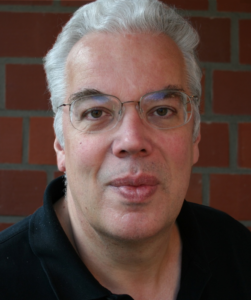 Thomas Grüter is medical doctor and is an affiliate at the Chair of General Psychology and Methodology at the University of Bamberg. He has published a number of popular science articles for Spektrum.de, Spiegel online, NZZ and other newspapers and magazines. For several years he has also published science fiction short stories. The short story “Meine künstlichen Kinder” (“My Artificial Children”) was nominated for the German Science Fiction Award 2022. He lives in Münster in the northwest of Germany.